Forget stocks for a second.
While the high-flying tech giants and their dizzying market caps dominate headlines, they pale in comparison to the monolithic forces that truly move the needle on a global scale.
We’re talking about the bedrock of human civilization – the commodities we burn, build with, and trust to hold value.
In this deep dive, we shift the lens from individual companies to the gargantuan types of asset classes that form the very fabric of the global economy.
Welcome to the trillions club, where oil isn’t just a barrel and the dollar isn’t just paper.
1. The Bedrock: Real Estate and the Value of ‘Home’
Let’s start with the undisputed heavyweight. If all of humanity’s wealth was a mountain, real estate would be its base. It’s difficult to pin down an exact, real-time value, as it encompasses everything from skyscrapers in Manhattan to small farms in rural India.
However, according to a 2021 report by Savills, the total value of all global real estate was estimated at a staggering 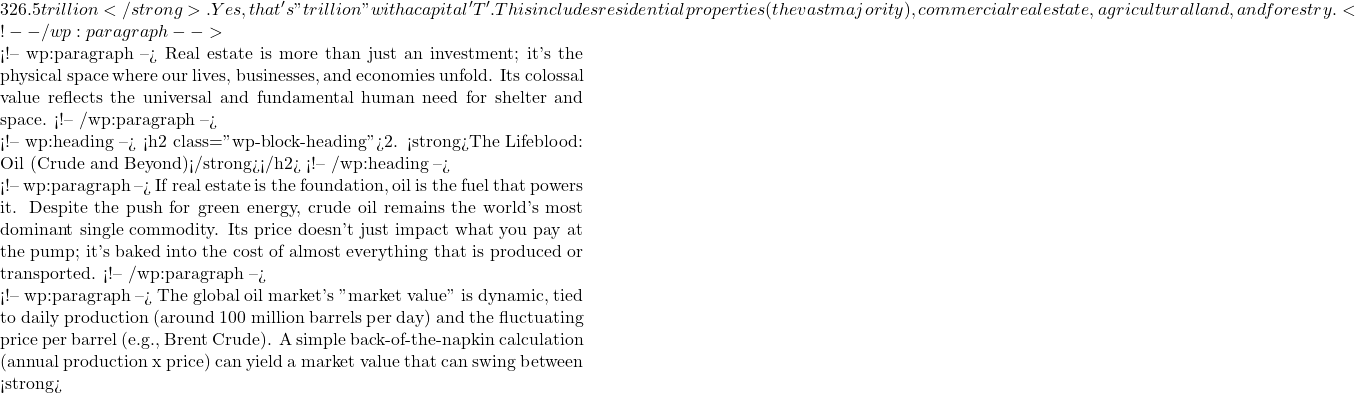 2 trillion and
 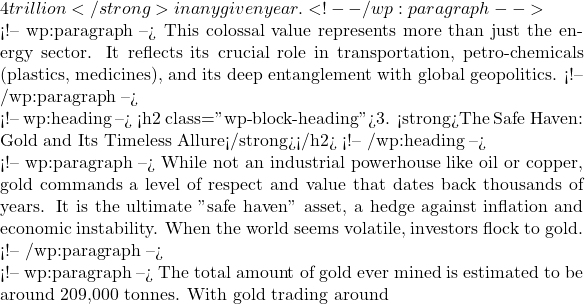 2,300 per ounce (as of mid-2024), the total market capitalization of all physical gold is roughly
 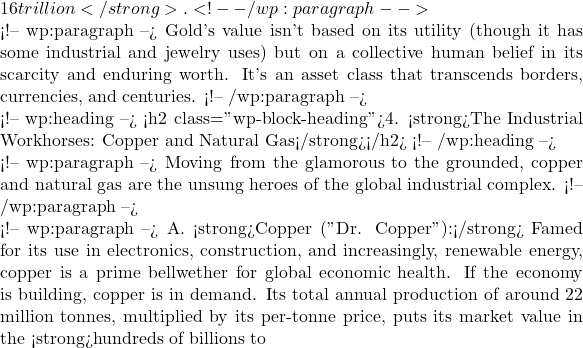 1 trillion range annually. The rise of EVs and renewable grids is only increasing its strategic importance.
B. Natural Gas: A crucial transition fuel as the world shifts away from coal, natural gas powers industries and heats millions of homes. The market for natural gas is more regional than oil due to pipelines, but the rise of Liquefied Natural Gas (LNG) is globalizing it. Estimates for the total value of the physical natural gas market (proven reserves) and its annual trade are complex but run into the trillions of dollars. The recent energy crisis in Europe underscored its critical value to national and regional economies.
5. The Pillars of Fiat: The World’s Dominant Currencies
Finally, we have the ultimate medium of exchange: money itself. Specifically, the currencies that lubricate all the other trades we’ve discussed. When we talk about the “market value” of a currency, we mean its share of global reserves and its daily trading volume in the Forex market.
a.) US Dollar (USD): The unmatched king. As the world’s primary reserve currency, the USD is involved in nearly 90% of all global foreign exchange transactions. Central banks hold vast amounts of USD as a stabilizing force, and it is the dominant pricing currency for commodities from oil to gold. Its “value” to the global financial system is incalculable.
b.) Euro (EUR): The second-most important reserve currency, the Euro represents a powerful economic bloc. It handles a significant portion of global trade and acts as a powerful counterbalance to the USD in the Forex markets.
c.) Chinese Yuan (CNY): The rising challenger. As China has become the world’s workshop and its second-largest economy, its currency’s influence is growing. While not as liquid as the USD or EUR, the Yuan is increasingly being used in trade settlement and is a growing component of central bank reserves.
d.) Japanese Yen (JPY): Known as a traditional “safe haven” currency due to Japan’s stable economy and large current account surpluses. While its value has fluctuated significantly against the dollar, it remains a critical currency in Asia and the 4th most held reserve currency.
The Takeaway
Looking at global assets from this perspective reveals a fascinating truth: the world’s true economic muscle doesn’t reside in speculative technology or even individual company profits. It’s rooted in the physical and the fundamental.
From the land we walk on to the oil that powers our machines and the currencies that facilitate our trade, these titanic asset classes remind us that the global economy is, first and foremost, a massive system built to fulfill core human needs and desires.
A single tech giant might have a higher market cap than the entire copper industry, but which one would we truly be more desperate for if it disappeared tomorrow?
The answer is a powerful reminder of what actually makes our world run.
