Selecting the best HR software for small business depends heavily on its specific needs, budget, and growth plans. Since you’re looking for the best options, I’ve compiled a detailed analysis of top-rated HR software, focusing on key features essential for a small business, along with real business examples.
Top-Rated HR Software for Small Business
Based on current reviews and market presence, the top HR software solutions for small to medium-sized businesses (SMBs) often fall into three main categories: All-in-One Platforms, HR-Focused/Employee-Centric Systems, and Specialized Solutions (like global or payroll-focused).
All-in-One HR Platforms
These platforms offer a comprehensive suite of tools, often starting with a strong core like payroll or IT, and expanding into a complete Human Resource Information System (HRIS).
| Software | Best For | Key Features for Small Business |
| Gusto | Payroll and Compliance for US-Based Teams | Full-service payroll (taxes, filings), benefits administration, time tracking, employee self-service, and new-hire reporting. |
| Rippling | Integrating HR, IT, and Finance | Unified platform for HR & IT management, automated payroll, benefits, and seamless onboarding/offboarding including device and app access setup. |
| ADP (RUN Powered by ADP) | Robust Payroll and Compliance Support | Specifically tailored for small business payroll, compliance management, and a suite of core HR tools. |
HR-Focused and Employee-Centric Systems
These solutions typically excel in managing the employee lifecycle, focusing on experience, culture, and ease of use, often with integrated or add-on payroll.
| Software | Best For | Key Features for Small Business |
| BambooHR | User-Friendly Employee Experience and Onboarding | Excellent for managing employee data, applicant tracking (ATS), performance management, and time-off tracking with a highly intuitive interface. |
| Zoho People | Affordability and Integration with other Business Apps | Core HR, time and attendance, performance management, and strong integration with the wider Zoho suite (CRM, Finance, etc.). |
| HiBob (bob) | Modern, Engaged, and Hybrid Workforces | Focuses on employee engagement, personalized communication, core HR, and performance management, ideal for scaling culture. |
Essential HR Software Features for Small Businesses
For a small business, the goal of HR software is to automate administrative burdens, ensure compliance, and free up time for strategic growth. The following features are non-negotiable for a strong system.
1. Core HR and Employee Records Management
A centralized, secure digital database is the foundational element of any HRIS. This feature replaces messy spreadsheets and paper files, acting as a single source of truth for all employee information.
A quality system should offer secure digital storage for employment contracts, performance reviews, and compliance documents. The ability to quickly search and pull data for reporting is critical for management decision-making.
2. Payroll and Tax Compliance
Payroll is often the most time-consuming and high-risk task for a small business. The best software automates payroll runs, calculates and files federal and state taxes, and handles direct deposits, significantly reducing the chance of costly compliance errors.
The system should have built-in updates to reflect changing labor laws and tax regulations, a major advantage for businesses expanding across different states or countries. Gusto, for example, is specifically renowned for simplifying complex US payroll and tax administration.
3. Time Off and Attendance Tracking
Manual tracking of PTO (Paid Time Off) and employee hours leads to errors and disputes. A good HR system automates the entire process, including digital clock-in/out options and automated PTO request workflows.
This automation ensures accurate time accruals, simplifies approval processes, and automatically feeds verified hours directly into the payroll system. This is especially helpful for small businesses with hourly or shift workers.
4. Employee Self-Service (ESS) Portal
Empowering employees to manage their own basic HR tasks is one of the biggest time-savers for small business owners and HR staff. An ESS portal allows employees to update personal information, view pay stubs, check PTO balances, and submit time-off requests.
This not only improves employee satisfaction by giving them 24/7 access to their data but also drastically cuts down on repetitive administrative questions directed to managers or HR.
5. Recruiting and Onboarding
The right software can streamline the entire process of bringing new talent into the business. An Applicant Tracking System (ATS) within the HR software centralizes job postings, tracks candidates through the hiring pipeline, and organizes all communication.
Following the hire, automated onboarding workflows ensure new employees complete all necessary tax forms, compliance documents, and training checklists digitally before their first day. This creates a professional and efficient first impression.
Real Business Examples
Successful small businesses worldwide leverage HR software to scale their operations efficiently and maintain a strong employee focus.
BambooHR: The Employee-Centric Approach
A global example of success with BambooHR is Freshly, a US-based meal delivery service. As Freshly rapidly grew its workforce, their CEO emphasized the challenge of maintaining a great employee experience while scaling.
By using BambooHR, Freshly was able to centralize its employee data and automate key processes like time-off requests and performance reviews. The user-friendly interface helped managers and employees feel more connected and autonomous, supporting rapid growth while keeping administrative overhead low.
Gusto: Payroll Automation in the US Market
Blue Star Donuts, a popular artisanal donut shop that expanded across multiple US states, faced a major headache with multi-state payroll, tax filing, and benefits administration for its growing team.
They adopted Gusto for its specialized, easy-to-use payroll features. Gusto’s automated tax filing and compliance management for different states allowed the business owners to shift their focus from complex administrative tasks to developing new recipes and opening new locations.
Zoho People: Scalability for Global SMBs
Khatabook, a high-growth fintech startup in India, utilized Zoho People to manage its quickly expanding team. Since they were already using other Zoho applications, the seamless integration was a significant benefit.
Zoho People helped them standardize performance management and employee time-off requests across their remote and in-office teams. The cost-effective modular design allowed them to add more sophisticated features, like performance review tools, as the company grew from a small startup to a mid-sized operation.
Conclusion: Choosing Your Best Fit
The best HR software for your small business is the one that directly addresses your greatest immediate need while offering scalability for future growth.
- If your primary pain point is complex payroll, tax filing, and US-specific compliance, Gusto or RUN Powered by ADP are excellent starting points.
- If your focus is on creating a great, user-friendly experience for employees and streamlining onboarding and performance tracking, BambooHR is a top contender.
- If you need a system that combines HR functions with IT and device management from day one, Rippling offers a unique, powerful, all-in-one solution.
Your choice should prioritize ease of use, transparent pricing (usually per-employee, per-month), and the ability to integrate with any existing accounting or business software you already rely on.
—
Comparing HR Software Pricing Structures: Gusto vs. BambooHR vs. Rippling
Comparing the pricing structures of the leading small business HR software is crucial because they use fundamentally different models. Gusto is known for its transparent payroll-first pricing, BambooHR for its flat-rate small business core HR model, and Rippling for its modular, scalable approach.
Here is a breakdown of their pricing structures and an estimated cost calculation for a 25-employee team.
1. Gusto: Payroll-First and Transparent
Gusto’s pricing is structured to be transparent and is ideal for US-based small businesses whose primary need is full-service payroll and tax compliance.
| Gusto Plan Name | Base Monthly Fee | Per-Employee Monthly Fee (PEPM) | Estimated Monthly Cost for 25 Employees | Best For |
| Simple |  6 6 |  49 + ( 49 + ( 80 80 |  380 ( 380 ( 12 x 25)) 12 x 25)) | Multi-state payroll, PTO tracking, basic hiring/onboarding. |
| Premium |  22 22 |  180 + ( 180 + (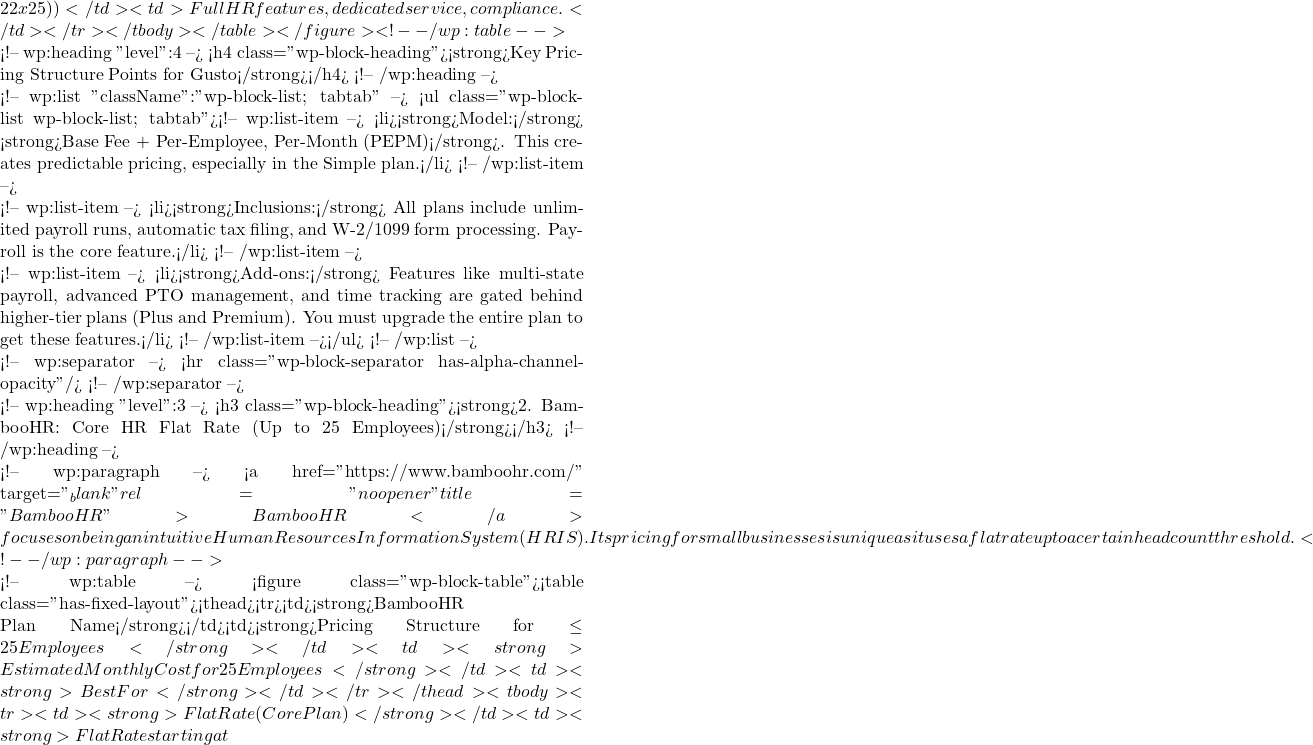 250/month (price is custom/quote-based) 250/month (price is custom/quote-based) |  300+ (Estimate) 300+ (Estimate) | Employee data, onboarding, applicant tracking, time-off management. |
| Modular Add-ons | Payroll, Time Tracking, and Performance Management are separate add-on modules billed monthly. | Variable. Adding Payroll and Time Tracking can increase the cost significantly. | Excellent employee experience and data management. |
Key Pricing Structure Points for BambooHR
- Model: Flat Rate for Small Businesses (then PEPM for >25 employees) + Modular Add-ons.
- Inclusions: The base Core Plan typically includes the HRIS (employee data), hiring/onboarding, and time-off tracking.
- Payroll is an Add-on: Unlike Gusto, payroll is not included in the base price and is a separate paid feature (US-only). This is important if payroll is your main driver.
- Custom Quotes: While the flat rate provides a starting point, final pricing is quote-based and requires contacting their sales team, which can make initial budgeting difficult.
3. Rippling: Modular and Scalable Platform
Rippling is designed as a highly powerful, modular platform for HR, IT, and Finance. You build your stack and only pay for the modules you activate.
| Rippling Plan Component | Pricing Structure | Estimated Monthly Cost for 25 Employees (Base HR + Payroll) | Best For | |
| Rippling Core Platform (HRIS) | Starts at  200 (25 x 200 (25 x  8+ PEPM) 8+ PEPM) |  8, Estimate) 8, Estimate) | Global payroll, compliance, and automated salary sync. | |
| Total Estimated Cost | Base + Selected Modules | 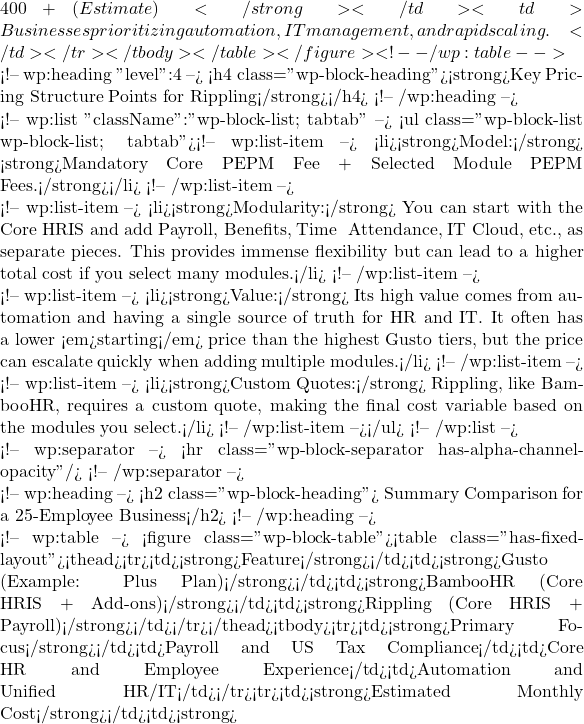 380 (Plus Plan) 380 (Plus Plan) | 300+ (Base HRIS) | $400+ (Base HRIS + Payroll) |
| Core Payroll Inclusion | Included (Auto-filing and unlimited runs) | Add-on (Separate monthly fee) | Add-on (Separate monthly fee) | |
| Pricing Transparency | High (Clear base fee + PEPM) | Low (Flat rate quoted, add-ons not published) | Medium (Core published, modules quoted) | |
| Best For Small Business | Predictable budget and payroll simplicity. | Prioritizing culture/employee data over complex payroll. | High-growth, tech-forward, or globally hiring teams. |
In conclusion:
- Gusto offers the most predictable and budget-friendly solution if your main priority is easy, compliant payroll.
- BambooHR is likely the most affordable for pure HR software (employee data, time off, onboarding), but adding payroll will increase the cost.
- Rippling is the most powerful and scalable but requires careful budgeting as you stack the necessary modules.
