The Kelly Criterion: Optimal Capital Allocation Strategy for Corporate Growth and Investment Management.
The Kelly Criterion is a foundational formula in capital allocation, risk management, and portfolio optimization that determines the mathematically optimal proportion of assets to commit to a given investment opportunity. By calculating the exact position size required to maximize long-term geometric compounding while preventing catastrophic drawdowns, The Kelly Criterion offers corporate decision-makers, portfolio managers, and venture capitalists a rigorous framework to navigate uncertainty and elevate financial performance.
Introduction to The Kelly Criterion
Every corporate executive, portfolio manager, and capital allocator faces a central strategic dilemma: how to balance risk and reward when committing financial resources to new ventures. Committing too little capital to a high-probability, high-return initiative leaves significant economic value on the table. Conversely, committing too much capital exposes the enterprise to devastating drawdowns or potential insolvency.
Originally formulated in 1956 by researcher John L. Kelly Jr. at AT&T Inc. Bell Labs to resolve signal noise issues in telecommunications, The Kelly Criterion was quickly recognized as a groundbreaking decision-making tool for capital deployment under uncertainty. When applied to business investments, stock selection, and corporate project evaluation, The Kelly Criterion identifies the specific percentage of an institution’s total balance sheet or investment bankroll that should be allocated to a specific trade or capital project to achieve maximum compound growth over a repeated horizon.
The Mathematical Foundation of The Kelly Criterion
At its core, The Kelly Criterion maximizes the expected logarithm of wealth, which is mathematically equivalent to maximizing the long-term geometric growth rate of capital. Unlike simple arithmetic expectations that ignore volatility and serial compounding, the logarithmic utility function accounts for the severe asymmetry of compounding losses. For instance, a 50% loss requires a 100% gain simply to return to break-even.
The Basic Formula
In scenarios where an investment yields discrete binary outcomes (a defined win or loss relative to the initial stake), The Kelly Criterion is represented as:
![\[f^* = \frac{b \cdot p - q}{b}\]](https://www.SuperBusinessManager.com/wp-content/ql-cache/quicklatex.com-215f0cb6b5f502e1e05ae033fcafcc80_l3.png "Rendered by QuickLaTeX.com")
Where the variables are defined as:
 : The optimal fraction of current total capital to allocate to the investment.
 : The probability of a successful outcome (the winning probability).
 : The probability of an unsuccessful outcome (
 ).
). : The net odds received on the investment, expressed as the ratio of profit earned relative to the capital at risk.
If evaluates to zero or a negative number, The Kelly Criterion indicates that the enterprise possesses no statistical edge and should pass on the opportunity entirely.
The Continuous Market Formula
For liquid financial assets, corporate projects, and equities where returns follow continuous distributions rather than binary win-loss outcomes, The Kelly Criterion utilizes expected excess return and variance:
![\[f^* = \frac{\mu - r}{\sigma^2}\]](https://www.SuperBusinessManager.com/wp-content/ql-cache/quicklatex.com-44a940c4d446606242e8e75112a221ff_l3.png "Rendered by QuickLaTeX.com")
Where:
 : The expected total return of the asset or project.
 : The risk-free rate of return (such as benchmark government treasury yields).
 : The variance of the return distribution.
This formulation illustrates that optimal leverage or position size is directly proportional to the risk-adjusted excess return (related to the Sharpe ratio) and inversely proportional to the variance of the underlying asset.
The Kelly Criterion Formula in Practice
To evaluate how The Kelly Criterion dictates capital deployment across varying risk profiles, consider the following strategic scenarios involving corporate project investments or equity acquisitions.
| Scenario / Opportunity Type | Estimated Win Probability (p) | Net Odds Ratio (b) | Formula Calculation (f∗=bbp−q) | Optimal Capital Allocation (f∗) |
| High Probability / Low Payout (Core Product Expansion) | 0.80 | 0.50 | 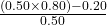 | 40.0% of Capital |
| Moderate Probability / Asymmetric Upside (Market Entry) | 0.60 | 1.50 | 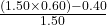 | 33.3% of Capital |
| Symmetrical Coin Flip with Edge (Cost Optimization Deal) | 0.55 | 1.00 | 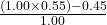 | 10.0% of Capital |
| Low Probability / High Payoff (Speculative R&D Venture) | 0.25 | 4.00 | 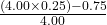 | 6.25% of Capital |
| Negative Expectation (Unfavorable Strategic Acquisition) | 0.45 | 1.00 | 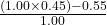 | -10.0% (Zero Capital) |
As demonstrated in the table, The Kelly Criterion enforces strict discipline: opportunities with moderate probabilities but high payout ratios earn lower capital allocations than high-probability core expansions, preventing companies from over-leveraging on speculative bets.
Corporate Capital Allocation and The Kelly Criterion
In modern corporate strategy, executive teams act as capital allocators. How a company allocates its free cash flow—whether into internal research and development, capital expenditures, strategic mergers and acquisitions, share buybacks, or dividend distributions—determines its long-term market valuation and shareholder value creation.
Concentrated Capital Deployment at Berkshire Hathaway
The real-world application of The Kelly Criterion principles is evident in the investment methodology of Berkshire Hathaway Inc. under Warren Buffett and Charlie Munger. Traditional portfolio theory advocates for broad diversification across hundreds of assets to minimize unsystematic risk. However, The Kelly Criterion demonstrates that when an investor or firm possesses a significant, durable advantage (or “economic moat”), concentrating capital into high-conviction ideas accelerates long-term compounding.
For example, when Berkshire Hathaway Inc. initiated its equity position in Apple Inc. in 2016, the conglomerate systematically scaled the investment until it comprised over 40% of its public equity portfolio, representing an aggregate capital deployment exceeding USD30 billion. By recognizing an asymmetric opportunity where the downside risk was constrained by Apple Inc.‘s cash generation and brand equity, Berkshire Hathaway Inc. aligned its capital deployment with Kelly-style optimization, yielding over USD100 billion in unrealized and realized gains over the subsequent decade.
Research and Development Sizing at Microsoft Corporation
In technological corporate environments, The Kelly Criterion informs how companies size strategic initiatives. Consider Microsoft Corporation and its multi-billion dollar strategic investments in artificial intelligence infrastructure. Rather than allocating identical cash reserves to dozens of unproven software projects, Microsoft Corporation concentrated capital into its cloud computing partnership with OpenAI, deploying over USD13 billion.
Because the expected payoff of leading the enterprise cloud AI architecture was exceptionally large relative to the downside risk, The Kelly Criterion logic supported committing a major fraction of annual capital expenditures to this single high-conviction strategic thrust.
Practical Variations: Full Kelly vs. Fractional Kelly
While theoretical The Kelly Criterion (referred to as “Full Kelly”) guarantees the maximum asymptotic growth rate over infinite iterations, applying Full Kelly in real-world business environments introduces extreme volatility.
The Volatility and Drawdown Challenge
A Full Kelly approach assumes exact knowledge of underlying probability distributions () and payoff ratios (). In actual business environments, these probabilities are estimates subject to parameter uncertainty, structural macroeconomic shifts, and unexpected competitive responses.
Under Full Kelly sizing:
- A firm faces an estimated 50% probability of experiencing a 50% peak-to-trough drawdown in total wealth at some point during its investment horizon.
- Overestimating the probability of success () by even a small percentage causes over-betting, which drastically lowers long-term compound returns and introduces severe risk of corporate distress or bankruptcy.
The Fractional Kelly Solution
To manage parameter uncertainty and cushion against volatility, institutional allocators, hedge funds, and corporate strategists overwhelmingly employ Fractional Kelly strategies—most notably Half Kelly.
![\[\text{Fractional Allocation} = k \cdot f^* \quad \text{where } 0 < k < 1\]](https://www.SuperBusinessManager.com/wp-content/ql-cache/quicklatex.com-caa6cf7e1ebc2d82c89f6e927bceb7c3_l3.png "Rendered by QuickLaTeX.com")
Under a Half Kelly approach ( ):
):
- Capital Protection: The allocation size is cut by 50%, dramatically reducing variance and portfolio drawdowns.
- Growth Rate Preservation: Despite reducing capital exposure by half, the expected long-term growth rate decreases by only 25% (achieving 75% of the theoretical maximum growth rate).
- Safety Margin: The remaining 50% of unused capital acts as an operational buffer against model misspecifications, black swan events, or unexpected cash flow constraints.
Corporate financial officers who deploy Half Kelly frameworks maintain balance sheet flexibility, protecting credit ratings while still achieving compounding efficiency.
Risks, Pitfalls, and Constraints in Real-World Business Applications
While The Kelly Criterion provides a powerful framework for capital allocation, successful execution requires addressing several practical limitations:
- Non-Stationary Probabilities: Unlike casino games with fixed probabilities, market dynamics, market demand, and macroeconomic variables evolve constantly. Probability estimates based on historical data can quickly fail during structural market shifts.
- Liquidity Constraints: Theoretical Kelly assumes capital can be dynamically adjusted continuously. In corporate M&A or large-scale infrastructure investments, capital commitments are illiquid and irreversible.
- Correlation Risk: Deploying The Kelly Criterion across multiple simultaneous projects requires accounting for inter-asset correlations. Unhedged concurrent bets on correlated revenue streams can aggregate total enterprise risk well beyond safe thresholds.
- Executive Risk Aversion: Institutional stakeholders, public market investors, and regulators often operate under strict downside constraints that prioritize capital preservation over pure geometric growth maximization.
Conclusions
The Kelly Criterion serves as an indispensable analytical instrument for corporate leaders, investors, and capital allocators seeking to maximize long-term wealth accumulation. By bridging probability theory and corporate finance, the model demonstrates that success depends not only on identifying profitable opportunities, but also on mathematically optimizing the magnitude of capital committed to each venture.
By adopting prudent modifications such as Fractional Kelly sizing, enterprises can aggressively pursue high-conviction growth initiatives—such as strategic M&A, research and development breakthroughs, and capital expenditure projects—while maintaining robust defenses against tail risk and market instability. Ultimately, mastering The Kelly Criterion transforms decision-making from subjective speculation into a disciplined, repeatable framework for sustainable long-term corporate growth.The Kelly Criterion: Optimal Capital Allocation Strategy for Corporate Growth and Investment Management
