The speed at which a business scales from inception to 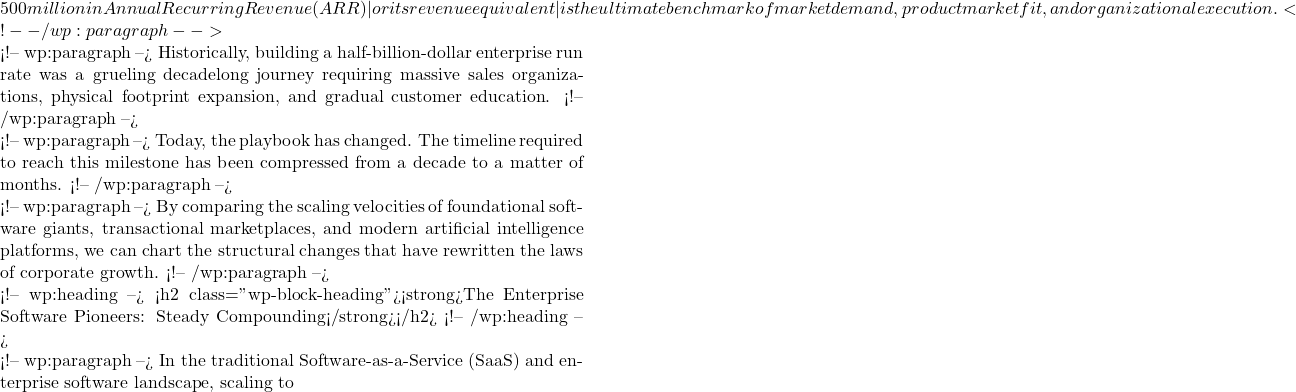 500 million ARR was an exercise in systematic land-and-expand strategies, long sales cycles, and category creation.
DocuSign
Founded in 2003, DocuSign had to build the entire infrastructure for electronic signatures from scratch. This required not just building software, but altering legal frameworks, establishing compliance standards globally, and convincing risk-averse enterprise legal teams to ditch paper. DocuSign took more than 12 years to reach the 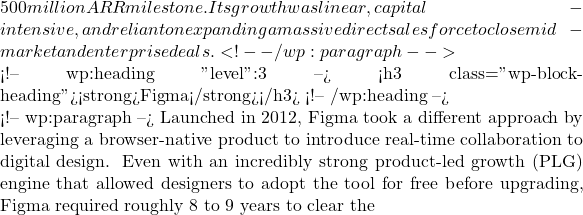 500 million ARR mark. Figma succeeded by expanding its addressable market out from core UI/UX designers to product managers and engineers, driving its annualized revenue past
 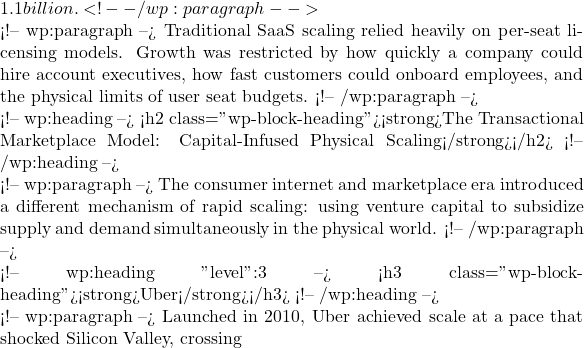 500 million in net revenue within roughly 4 to 5 years of its commercial launch. Unlike software companies that enjoy 80% gross margins and zero marginal costs of distribution, Uber had to scale city by city, country by country.
The strategy required recruiting hundreds of thousands of drivers, navigating complex local transit regulations, and spending billions of dollars on user acquisition. Uber proved that a marketplace could scale with unprecedented speed if it addressed an immediate, high-frequency consumer pain point and was backed by aggressive capital injection. However, the operational friction of real-world logistics meant that scaling revenue did not automatically translate into immediate profitability.
The Frontier AI Wave: Demand Explosion
The launch of large language models fundamentally altered the timeline of corporate growth. When the value proposition shifts from workflow optimization to direct task execution, consumer and enterprise adoption happens almost instantly.
OpenAI
OpenAI represents the first major inflection point in compressed scaling timelines. Prior to late 2022, OpenAI operated largely as a research laboratory with modest commercial revenue. The launch of ChatGPT changed everything. Driven by a consumer subscription model alongside a rapidly growing enterprise API developer platform, OpenAI rocketed from under  2 billion in 2023, blowing past the
  12 billion ARR, establishing the fastest scaling trajectory in technology history up to that point.
Anthropic
Anthropic followed a remarkably similar trajectory. Initially founded with a core focus on AI safety and research, the company commercialized its Claude model family via direct enterprise integrations and cloud provider partnerships with Amazon Web Services and Google. Anthropic’s ARR grew at a blistering pace, crossing  9 billion by late 2025. By mid-2026, its annualized run rate climbed even higher, proving that the market could simultaneously sustain multiple multi-billion-dollar foundation model platforms.
The Applied AI Anomalies: Pure Capital and Operational Efficiency
While foundation model developers require billions of dollars in capital to fund compute infrastructure, the companies building specialized applications on top of those models are experiencing a completely new type of hyper-scale.
Cursor
Developed by Anysphere, Cursor is an AI-powered code editor that has redefined the absolute limit of scaling velocity. Founded in 2022, Cursor focused intently on a highly technical, high-intent user base: software engineers. The tool blends seamlessly into existing developer workflows while fundamentally automating code creation and codebase contextualization.
The financial results have been unprecedented:
- January 2025: Cursor crossed
 500 million in ARR.
 - November 2025: Annualized revenue exceeded
 2 billion.
Cursor managed to jump from  500 million ARR in less than 6 months, and did so with an incredibly lean team of roughly 50 to 300 employees over its core growth phases. This represents an ARR-per-employee ratio that was completely unimaginable during the eras of DocuSign or Figma.
Company Era / Category Approx. Time to  100M)
100M)
Structural Drivers behind the New Scaling Reality
Three fundamental shifts explain why modern startups can scale from  500 million ARR at velocities that make legacy software growth look linear.
1. From Per-Seat Budgets to Token Consumption
Traditional software revenue is tied to human headcount. If a client company has 100 designers, Figma can sell a maximum of 100 seats. AI platforms like OpenAI, Anthropic, and Cursor frequently monetize via API consumption, compute usage, or high-volume token utilization. An individual software engineer utilizing an AI coding tool like Cursor or Claude Code to continuously read, write, and audit production code consumes thousands of times more data than a passive user clicking through a standard SaaS dashboard. The unit of value has shifted from licensing access to purchasing direct productivity.
2. Immediate Time-to-Value
Legacy software deployments require lengthy implementation phases, data migration, and employee retraining. In contrast, modern AI applications plug directly into existing infrastructure. A developer downloads Cursor and immediately works within their familiar setup, with AI instantly answering questions about millions of lines of proprietary code. When a tool eliminates friction instead of adding a new workflow to manage, organizational adoption spreads organically overnight.
3. Infinite Distribution Channels
When DocuSign started, selling software required physical servers, enterprise sales cycles, and face-to-face negotiations. Today, global cloud marketplaces, developer ecosystems, and viral social distribution allow a product to reach millions of users within hours of launch. Market awareness is instantaneous, and checkout friction is non-existent.
Conclusions
The journey from 500 million ARR highlights a structural transformation in how economic value is created and captured.
Legacy software companies built enduring value through slow, defensive compounding, relying on high switching costs and deep workflow integration.
Marketplaces like Uber expanded through sheer operational willpower and massive capital deployment to conquer physical geography.
The AI era has decoupled scaling velocity from headcount and physical constraints.
By monetizing systemic compute and direct task automation rather than human seats, companies can capture massive market share in windows of time previously reserved for initial product testing.
For modern enterprise managers and founders, the lesson is clear: market patience has evaporated, distribution channels are completely fluid, and product utility is judged by how much work the software executes on behalf of the user.
