So, should the business accept a special unprofitable order below total cost? At the first sight, it might appear to be unwise to accept a new order, or a new contract, that does not cover all the costs associated with producing one unit.
Should a firm accept a new order that does not cover full unit cost?
The business should accept the new order as long as additional contribution can be earned. This is because Indirect Costs (Overheads) must be paid anyway.
If contracts are accepted using prices below the full unit cost, this can lead to an increase in the total profits of the business. So, the overall profits will increase.
Also, new customers can be gained. Even though the business does not make a profit now, acquiring new customers can lead to further future orders that will create further value later.
When a firm is trying to enter a new market segment, then every customer matter. It is usually very difficult to find first customers.
Finally, if a firm has enough spare capacity, then Contribution-Costing Technique can assist managers in deciding whether to accept an order at below the full cost. It is usually better to earn any contribution from additional customers than to leave the factory, hotel rooms or shops empty.
Example 1: This is why hotels often offer very low rates to customers in off-peak seasons – to earn a contribution even though they are making a loss.
An example when the business should not refuse a new order or contract even below full costs
The following example illustrates this principle of using marginal costing in accepting new business.
A sole trader runs a cake shop and produces birthday cakes. Indirect Costs (Overheads) of this young female entrepreneur are USD 30 each cake. To make each cake, she incurs the Direct Costs of USD
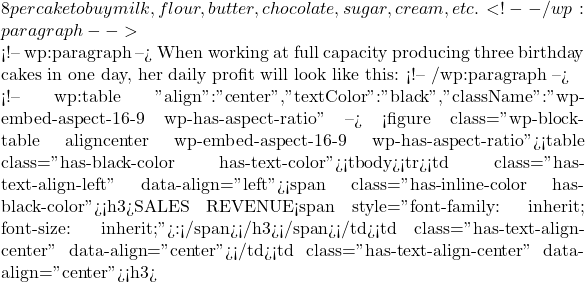 90
90
 30
30TOTAL COSTS (TC):
 46
46
She is able to make a daily profit of USD 18:
18:
| DIRECT COSTS per cake: |  10 10 | |||||||||||||||||||
AVERAGE COST (AC) per cake: |
|
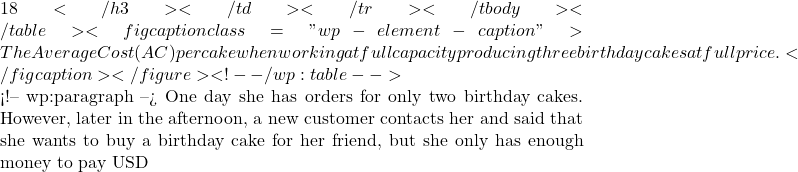 20 for that cake.
  30 each.
SALES REVENUE: |
| |
| INDIRECT COSTS: |  46 46 | |
PROFIT: |
| |
| DIRECT COSTS: | 30 | |
TOTAL COSTS (TC): |
|
 16
16 14. The unit cost of producing one birthday cake is USD
 30 each, and one cake at USD
 80
80She will make a profit of USD 20. The unit cost of producing one cake is the same USD$18 as when producing and selling cakes at the regular price. Because she lowered the price for making that third cake, she will earn less profit that day.
When the business should not accept a new order that does not cover full unit cost?
Firstly, when high prices help to establish the exclusivity of a brand, then offering some customers lower prices could destroy that luxurious brand image.
Secondly, existing customers may learn that the lower prices are being offered to some other customers. They may demand similar or identical treatment. If all products sold by a business are sold at the contribution-cost price then this could make earning a profit very unlikely.
Thirdly, where there is no excess capacity. It is because the business only has enough capabilities to produce products and sell them at regular prices. When selling products at the contribution-cost price, they firm may be losing sales revenue based on the full-cost price.
Lastly, sometimes lower-priced goods or services may be resold into the higher-priced market segment. In fact, many businesses do use contribution-cost pricing, but try to make sure that there is no leak into the higher-priced market, e.g. airlines, railways companies, cinemas, amusement parks, etc.
Even though a positive contribution can be made by accepting an order, there are real dangers that other customers will find out that a lower price is being offered on the particular contract. Qualitative factors are important too for businesses and must be carefully considered by managers.

I am the Founder and Editor-in-Chief of the SuperBusinessManager.com website. I am the EU citizen with approximately 20 years of experience in secondary and higher business education in both public and private sectors. Currently living with my wife and our two adorable children in China where I teach Business Management and Economics at K-12 international schools. Professionally, I am an experienced Lecturer and Researcher in Business Management and Economics, as well as IB Examiner for DP Business Management at International Baccalaureate (IB). Privately, I enjoy reading and collecting books on business management, personal finance and investing. You can contact me at jerrygrzegorzek@hotmail.com
Comments are closed.