Return on Capital Employed (ROCE) is ratio between Net Profit Before Interest and TAX, and Capital Employed. It compares Net Profit Before Interest and TAX with Capital Employed. Capital Employed is Share Capital plus Retained Profit (all the money that has been invested in the business by the owners) plus Long-term Liabilities (all long-term debt).
What does Return on Capital Employed (ROCE) measure?
Return on Capital Employed (ROCE) shows Net Profit Before Interest and TAX as a percentage of Capital Employed. This ratio tells us how much Net Profit Before Interest and TAX is earned for every USD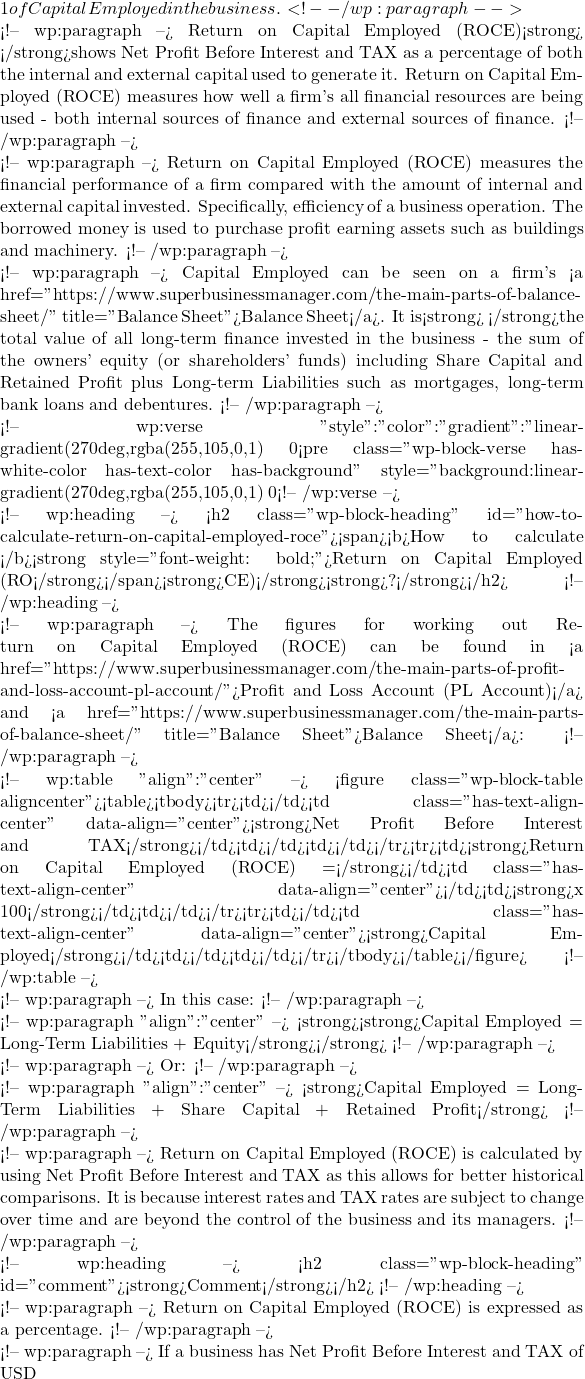 500,000, and Capital Employed of USD
 100 of capital invested in the business, USD
![50 of Net Profit Before Interest and TAX is generated. <!-- /wp:paragraph --> <!-- wp:paragraph --> Return on Capital Employed (ROCE) is of little use unless it is compared with the business's results from previous years and with results of similar businesses in the industry. Managers should compare Return on Capital Employed (ROCE) with other businesses in the same industry. It is because Return on Capital Employed (ROCE) will vary between industries. As a general rule, if Return on Capital Employed (ROCE)increases from one year to the next, or the business has a higher Return on Capital Employed (ROCE) than competitors, the business's profitability has improved or is better than similar firms in the industry. <!-- /wp:paragraph --> <!-- wp:paragraph --> Return on Capital Employed (ROCE) should be above 20%. <!-- /wp:paragraph --> <!-- wp:paragraph --> Of course, the higher Return on Capital Employed (ROCE), the better for the business. By comparing a company's Return on Capital Employed (ROCE) to the industry's average, this ratio may provide insight into how the company management is using firm's total long-term financial resources (both internal sources of finance and external sources of finance) to grow the business. A sustainable and increasing Return on Capital Employed (ROCE) over time can mean a company is good at investing all internal and external financing (both shareholders' money and lenders' money), so as to increase productivity and profits. In contrast, a declining Return on Capital Employed (ROCE) can mean that management is making poor decisions on investing money in unproductive assets. <!-- /wp:paragraph --> <!-- wp:paragraph --> When Return on Capital Employed (ROCE) is higher than the cost of acquiring that capital (i.e. the interest on the bank loan or the bond's coupon rate), it would make a favorable investment. But when Return on Capital Employed (ROCE) is lower than the cost of acquiring that capital, it would make an unfavorable investment. Here, the existing shareholders and lenders would choose to exit while potential investors and lenders would prefer to stay away. <!-- /wp:paragraph --> <!-- wp:verse {"style":{"color":{"gradient":"linear-gradient(270deg,rgba(255,105,0,1) 0%,rgb(207,46,46) 100%)"}},"textColor":"white"} --> <pre class="wp-block-verse has-white-color has-text-color has-background" style="background:linear-gradient(270deg,rgba(255,105,0,1) 0%,rgb(207,46,46) 100%)"><strong>When Return on Capital Employed (ROCE) is higher than Return on Equity (ROE), it means that the return a company generates on capital owned by lenders is higher than the return a company generates on capital owned by shareholders (investors). It is good for lenders, but not good for shareholders (investors).</strong></pre> <!-- /wp:verse --> <!-- wp:separator {"opacity":"css"} --> <hr class="wp-block-separator has-css-opacity"/> <!-- /wp:separator --> <!-- wp:html --> <script async="" src="https://pagead2.googlesyndication.com/pagead/js/adsbygoogle.js?client=ca-pub-3196649779609103" crossorigin="anonymous"></script> <!-- Inside Content --> <ins class="adsbygoogle" style="display:block" data-ad-client="ca-pub-3196649779609103" data-ad-slot="4855547878" data-ad-format="auto" data-full-width-responsive="true"></ins> <script> (adsbygoogle = window.adsbygoogle || []).push({}); </script> <!-- /wp:html --> <!-- wp:separator {"opacity":"css"} --> <hr class="wp-block-separator has-css-opacity"/> <!-- /wp:separator --> <!-- wp:heading --> <h2 class="wp-block-heading" id="example-for-return-on-capital-employed-roce"><span><b>Example for </b><strong style="font-weight: bold;">Return on Capital Employed (ROCE)</strong></span></h2> <!-- /wp:heading --> <!-- wp:paragraph --> <strong>COMPANY A</strong> <!-- /wp:paragraph --> <!-- wp:paragraph --> Company A has Sales Revenue of USD](https://www.SuperBusinessManager.com/wp-content/ql-cache/quicklatex.com-b7deb24bf99962d08de7f131a3c3e476_l3.png "Rendered by QuickLaTeX.com") 1,000,000, Cost of Goods Sold (COGS) of USD
1,000,000, Cost of Goods Sold (COGS) of USD 300,000, Expenses (Overheads) of USD
 150,000 in 2020. One year later in 2021, Company A has Sales Revenue of USD
 600,000, Gross Profit of USD
 100,000, and Net Profit Before Interest and TAX of USD
 1,500,000 in both 2020 and remained unchanged in 2021. Capital Employed of Company A includes both Long-term Liabilities (Long-term Bank Loans and Debentures) which amount to USD
 1,000,000.
| 2020 | 2021 | ||||||
|---|---|---|---|---|---|---|---|
| Sales Revenue |  1,500,000 1,500,000 | ||||||
| Cost of Goods Sold (COGS) |  600,000 600,000 | ||||||
| Gross Profit |  900,000 900,000 | ||||||
| Expenses (Overheads) |  100,000 100,000 | ||||||
| Net Profit Before Interest and TAX | 800,000 | ||||||
| Capital Employed |  1,500,000 1,500,000 | ||||||
| Capital Employed = Long-term Liabilities + Share Capital + Retained Profit | |||||||
| Return on Capital Employed (ROCE) | 10% | ➚ | 53.3% |
What happened? In 2020, Company A has Net Profit Before Interest and TAX of USD 1,500,000. This gives us Return on Capital Employed (ROCE) of 10%. If Return on Capital Employed(ROCE) is 10%, it means that for every USD
 10 of Net Profit Before Interest and TAX is generated. However, in 2021, Company A has Net Profit Before Interest and TAX of USD
 1,500,000. This gives us Return on Capital Employed (ROCE) of 53.3%. If Return on Capital Employed (ROCE) is 53.3%, it means that for every USD53.3 of Net Profit Before Interest and TAX is generated.
Why it happened? It happened because Net Profit Before Interest and TAX increased from  800,000 in 2021. Higher Net Profit Before Interest and TAX was the result of higher Sales Revenue, lower cost of production Cost of Goods Sold (COGS) and lower Expenses (Overheads).
What does the change mean? Company A’s Return on Capital Employed (ROCE) is higher as the company managed to increase its revenue using the same Capital Employed meaning that the business’s profitability has improved. The management of Company A was more effective using firm’s financial resources (both internal sources of finance and external sources of finance) to grow the business.
Is it good or bad for the business? This is good for Company A as a sustainable and increasing Return on Capital Employed (ROCE) over time can mean that a company is good at investing all internal and external financing, so as to increase productivity and profits. The management of Company A is more effective at making the capital invested in the business earn profit. The higher the value of this ratio, the greater the return on the capital invested in the business by the lenders.
How to improve Return on Capital Employed (ROCE)?
Return on Capital Employed (ROCE) measures how well a firm is able to generate profit from its own sources of funds as well as long-term borrowings. Return on Capital Employed (ROCE) can be improved mainly by strategies to boost Net Profit Before Interest and TAX. Mathematically, Return on Capital Employed (ROCE) will also increase when Capital Employed falls whilst Net Profit Before Interest and TAX remains constant. Although, in reality this is probably not desirable as assets will be needed in the future for the expansion of the business.
Possible strategies to increase Return on Capital Employed (ROCE) include:
1. Increase Net Profit Before Interest and TAX:
This should be done without increasing Capital Employed. Meaning, without selling new shares to raise money, without retaining new profit or without borrowing any new money in the long-term. So, how to do that then?
- Increase Sales Revenue. This should be done by maintaining the profitable and efficient use of the assets owned by the business that were purchased by the capital employed, and building new revenue streams.
- Increase profit margins. Lower the cost of production Cost of Goods Sold (COGS) to increase Gross Profit Margin (GPM) ratio and lower Expenses (Overheads) to increase Net Profit Margin (NPM) ratio. You can also close down unprofitable business centers to eliminate inefficient costs.
- Lower TAXes. In general, the lower the TAX rate, the higher the profits (if all else equal).
2. Reduce Capital Employed:
This should be done by generating the same Net Profit Before Interest and TAX, but using less Capital Employed. So, how to do that then?
- Pay off some debt. This should be done by selling unproductive assets – everything that the business owns that contribute nothing or very little to generating Sales Revenue. Use the money from this sale of assets to pay off long-term debts. This will reduce Long-term Liabilities, hence reduce Capital Employed without impacting the business’s productive capacities.
- Restructure existing debt. This should be done by restructuring existing debt, refinancing at lower interest rates or with more attractive repayment terms.

Comments are closed.