Investing in bankruptcy and corporate restructuring—often termed distressed debt or special situations investing—represents one of the most sophisticated and specialized segments of the global financial markets. While public retail markets frequently view a Chapter 11 bankruptcy filing as a sign of irreversible failure, institutional asset managers, hedge funds, and private equity firms recognize corporate distress as an opportunity to acquire high-value assets at substantial discounts to their intrinsic worth.
At its core, distressed investing involves acquiring the financial instruments of a company experiencing operational, financial, or liquidity distress. These instruments can range from senior secured bank loans and high-yield bonds to trade claims and equity securities. The central mandate of bankruptcy investing is not to gamble on speculative turnarounds, but rather to evaluate a company’s capital structure, determine its true going-concern or liquidation value, and position capital where risk-adjusted returns are maximized under statutory insolvency law.
For corporate executives, investors, policymakers, and academics, understanding how capital is deployed during corporate reorganization provides vital insight into capital allocation efficiency, market price discovery, and corporate governance during financial distress.
Understanding the Bankruptcy Capital Structure and Legal Framework
To successfully invest in distressed corporate entities, an investor must master the legal hierarchy that governs distributions in bankruptcy court. In the United States, Chapter 11 of the Bankruptcy Code allows a corporate entity to restructure its balance sheet while maintaining operational continuity under court protection. Internationally, equivalent legal frameworks include the United Kingdom’s Companies Act Part 26A restructuring plan and European preventative restructuring frameworks.
The Absolute Priority Rule (APR)
The fundamental principle governing all bankruptcy distributions is the Absolute Priority Rule (APR). The APR mandates that senior classes of claims must be paid in full before any junior class receives any distribution or retains any property under a plan of reorganization.
Understanding where an investment sits within the capital waterfall dictates both the probability of principal recovery and the potential upside.
| Priority Level | Tranche / Claim Type | Security Characteristics | Typical Historical Recovery Rate Range |
| 1 (Highest) | Debtor-in-Possession (DIP) Loans | Super-priority credit facilities provided during Chapter 11 to fund ongoing operations. | 98% – 100% |
| 2 | Administrative & Priority Claims | Professional fees, post-petition trade obligations, tax liabilities, and employee wages. | 95% – 100% |
| 3 | Senior Secured Debt | First-lien bank loans, revolving credit facilities, and secured notes backed by specific collateral. | 70% – 95% |
| 4 | Junior / Second-Lien Secured Debt | Second-lien obligations secured by residual collateral value behind senior lenders. | 35% – 65% |
| 5 | Senior Unsecured Debt & Trade Claims | Senior notes, vendor trade credit, and lease rejection damages without specific collateral liens. | 15% – 50% |
| 6 | Subordinated / Mezzanine Debt | Contractually subordinated bonds and mezzanine notes. | 0% – 20% |
| 7 (Lowest) | Preferred & Common Equity | Residual ownership stakes; typically canceled upon emergence unless complete asset value exceeds total debt. | 0% – 5% |
Core Strategies for Investing in Bankruptcies
Distressed investors deploy several distinct strategies depending on their risk appetite, liquidity horizon, and targeted degree of active control.
1. The “Fulcrum Security” Strategy
The fulcrum security is defined as the specific class of debt in the capital structure that is not fully covered by the debtor’s enterprise value. Because this tranche sits precisely at the boundary where enterprise value runs out, holders of the fulcrum security are usually converted into the primary owners of the equity in the reorganized company upon exit from Chapter 11.
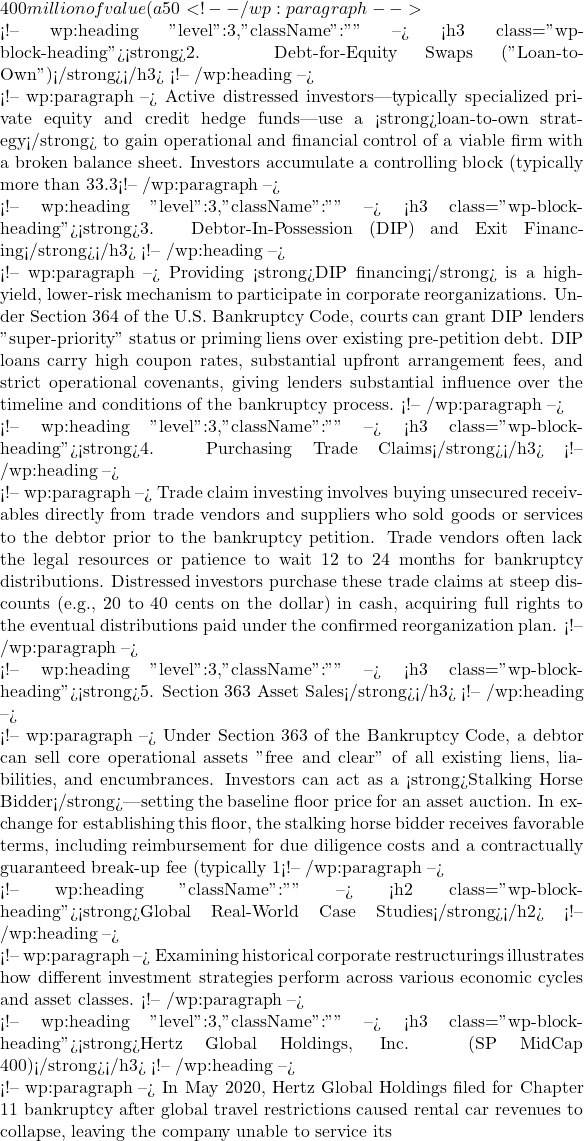
Investors identify the fulcrum tranche by estimating the firm’s reorganized enterprise value (REV). If a company is valued at 



- Investment Strategy & Outcome: Traditionally, common equity is wiped out in Chapter 11. However, an unprecedented surge in used car valuations dramatically inflated the liquidation value of Hertz’s fleet. A bidding war emerged between investment consortiums led by Knighthead Capital Management, Certares Opportunities, and Apollo Capital Management.
- Financial Recovery: The approved


Pacific Gas and Electric Company / PG&E Corp (S&P 500)
Pacific Gas and Electric Company (PG&E) filed for Chapter 11 protection in January 2019 under the pressure of estimated liabilities exceeding 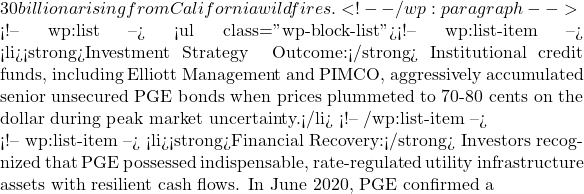

Lehman Brothers Holdings Inc. (S&P 500)
The September 2008 bankruptcy of Lehman Brothers Holdings Inc. remains the largest corporate insolvency in history, involving over 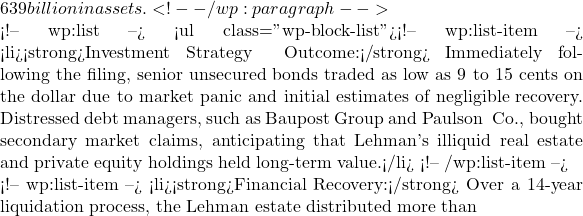

International Insolvencies: Samarco Mineração S.A. (Brazil)
Samarco Mineração S.A., a Brazilian iron ore joint venture between Vale S.A. and BHP Group, entered judicial restructuring following the 2015 Fundão dam collapse and subsequent debt default on over $4.7 billion in bond obligations. Foreign bondholders formed ad hoc committees to negotiate a cross-border debt-for-equity and long-term note restructuring. This highlighted how international distressed investing requires navigating foreign judicial systems, currency exchange risks, and complex regulatory approvals.
Comprehensive Valuation and Due Diligence Framework
Evaluating a distressed company requires specialized fundamental analysis that differs significantly from standard corporate valuation metrics.
+-------------------------------------------------------------------------+
|                  DISTRESSED DUE DILIGENCE WORKFLOW                      |
+-------------------------------------------------------------------------+
|  1. CASH FLOW & RUNWAY ANALYSIS                                         |
|     • Review 13-week rolling cash flow forecasts (TWCF).                |
|     • Calculate unencumbered cash liquidity and unbilled cash burns.    |
+-------------------------------------------------------------------------+
                                    |
                                    v
+-------------------------------------------------------------------------+
|  2. ENTERPRISE VALUATION (REV vs. LIQUIDATION)                          |
|     • Reorganized Enterprise Value (Discounted Cash Flow / Multiples).  |
|     • Orderly Liquidation Value (OLV) vs. Forced Sale Value (FSV).      |
+-------------------------------------------------------------------------+
                                    |
                                    v
+-------------------------------------------------------------------------+
|  3. LEGAL CAPITAL STRUCTURE AUDIT                                       |
|     • Perfection of security interest / Collateral coverage analysis.  |
|     • Intercreditor agreements & subordination terms.                   |
|     • Avoidance action exposure (Preferential & Fraudulent Transfers).  |
+-------------------------------------------------------------------------+
                                    |
                                    v
+-------------------------------------------------------------------------+
|  4. RESTRUCTURING PLAN & WATERFALL MODELING                             |
|     • Estimate class recovery percentages under APR.                   |
|     • Model potential plan cramdown scenarios and voting dynamics.      |
+-------------------------------------------------------------------------+
Key Metrics in Bankruptcy Analysis
- 13-Week Cash Flow Forecast (TWCF): The primary operational metric in Chapter 11. It tracks granular weekly cash receipts and disbursements to establish whether the debtor has sufficient liquidity to survive through reorganization without emergency asset sales.
- Reorganized Enterprise Value (REV): The estimated going-concern value of the company post-restructuring, derived from discounted cash flow (DCF) models using conservative post-exit projections and peer valuation multiples.
- Liquidation Value (OLV vs. FSV): The baseline floor valuation. Orderly Liquidation Value (OLV) assumes assets are sold over a reasonable time frame, whereas Forced Sale Value (FSV) reflects immediate auction proceeds.
Key Investment Risks and Legal Pitfalls
While distressed asset investing offers substantial risk-adjusted return potential, it entails severe structural and legal risks:
- Duration & Time Value Risk: Bankruptcy proceedings are notoriously prolonged. Extended litigation among creditor classes can delay plan confirmation for years, eroding annualized IRR even if nominal dollar recoveries match initial targets.
- Equitable Subordination: Under Section 510(c) of the Bankruptcy Code, the court may relegate a creditor’s claim to a lower priority if the creditor engaged in inequitable conduct that damaged other claimants.
- Avoidance Actions (Preferences and Fraudulent Transfers): Debtors or official creditor committees can claw back payments made to creditors within 90 days prior to the bankruptcy filing (or 1 year for insiders), claiming they constitute preferential transfers.
- Priming Risk: Existing secured creditors risk having their senior lien status “primed” (displaced to a lower priority) by newly issued court-approved DIP financing facilities.
Conclusion
Investing in bankruptcies and corporate restructurings is an analytical discipline that sits at the intersection of corporate finance, fundamental valuation, and legal strategy. Far from being a speculative gamble on failing businesses, structured distressed investing allows capital providers to acquire high-quality underlying operating assets or credit instruments at discounts to intrinsic value.
By rigorously mapping the capital structure, adhering to the Absolute Priority Rule, evaluating reorganized enterprise values against liquidation floors, and selecting appropriate entry instruments—whether DIP loans, trade claims, or fulcrum debt—investors can generate attractive returns while providing the liquidity and recapitalization essential for viable companies to re-emerge as going concerns.

