Doing business in Madagascar involves a streamlined process facilitated by a dedicated government agency, though foreign investors should be prepared for various legal and administrative requirements, often conducted in French.
The central point of contact for company registration is the Economic Development Board of Madagascar (EDBM), which operates a one-stop-shop for most formalities.
1. Key Considerations for Foreign Investors
- Foreign Ownership: Madagascar’s Investment Law generally allows for 100% foreign ownership in most sectors. The only notable restriction is in the telecommunications sector, where foreign ownership is capped at 66%.
- Official Language: The official languages are Malagasy and French. All legal documents, company statutes, and official communication must be prepared in French.
- Resident Representative: Most business entities, particularly the SARL and SA, are required to appoint a local representative who resides in Madagascar to handle official notices and compliance.
- Minimum Capital: The minimum capital requirement for the most common entities is generally very low (e.g., US
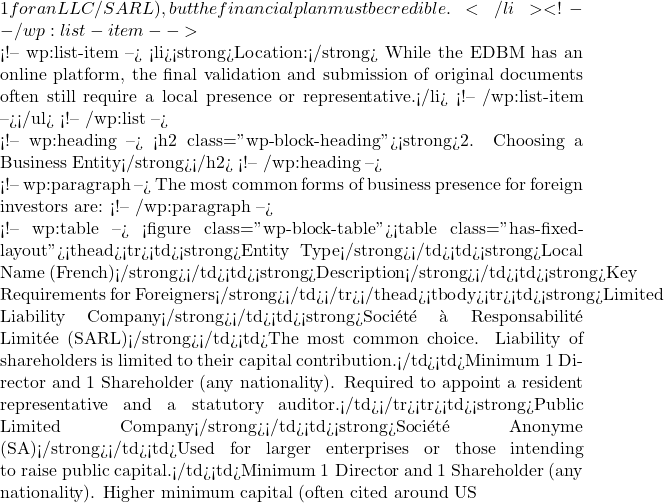 800). Required to appoint a resident representative and a statutory auditor.
Branch Office Succursale An extension of the foreign parent company. It can conduct commercial activities. 100% foreign-owned. Requires a registered office and a resident representative in Madagascar. Unlimited liability for the parent company. Representative Office Bureau de Représentation Can only engage in market research, liaison, and promotional activities. Cannot generate local revenue. 100% foreign-owned. Operating expenses must be covered by funds sent from the parent company abroad. Export Processing Zone (EPZ) Company Société en Zone Franche Requires special approval. Must export at least 95% of production to qualify for significant tax incentives (e.g., tax exemptions). Requires approval from the EDBM. 3. Company Registration Process (via EDBM One-Stop-Shop)
The registration process is centralized through the Economic Development Board of Madagascar (EDBM).
- Name Reservation: Reserve the company name through the Malagasy Business Register (often done via the EDBM).
- Document Preparation: Draft the company’s Bylaws (Statutes) in French. Gather required documents, which typically include:
- Application forms.
- Bylaws/Articles of Association.
- Passport/ID copies for all directors and shareholders.
- Proof of the registered office address in Madagascar.
- Non-residents working in Madagascar may need to obtain a CIPENS (Professional Identity Card for self-employed foreigners).
- A Criminal Record Certificate from the home country.
- Deposit and Submission: Submit the complete documentation, either in person or through a local representative, to the EDBM one-stop-shop. Pay the required administrative and registration fees.
- Registration and Identification Numbers: The EDBM will process the registration, which includes:
- Issuing the Certificate of Incorporation (K-Bis).
- Obtaining the Tax Identification Number (NIF) from the Tax Authority (DGI).
- Obtaining the Statistical Identification Number from the National Institute of Statistics (INSTAT).
- Obtaining the Commercial Registration Number (RCS).
- Post-Registration Formalities:
- Bank Account: Open a corporate bank account (local currency and/or foreign currency).
- Social Security: Register the company and its employees with the National Social Security Fund (CNAPS) and the relevant health insurance body (e.g., OSTIE).
- Labor Inspectorate: Notify the local Labor Inspectorate of the start of activity.
- Business License: Obtain any necessary industry or sector-specific operating licenses.
4. Taxation Overview
Madagascar’s tax system operates on a declarative basis, meaning the taxpayer is responsible for declaring turnover, calculating taxes, and making payments.
Tax Category Rate Details Corporate Income Tax (CIT) 20% Standard rate for companies with annual turnover exceeding MGA 400 million (approx. $90,000 USD). Synthetic Tax (IS) 5% of turnover Simplified tax regime for small companies (turnover less than MGA 400 million). Value Added Tax (VAT) 20% Standard rate. Applicable to most goods and services. Exports are zero-rated. Withholding Tax (WHT) 10% (on most income) Applied to Madagascan-source income paid to non-resident entities without a Permanent Establishment (PE). Interest on financial loans is generally subject to a 20% WHT. Note: Tax laws in Madagascar are updated annually, so current rates and thresholds should always be confirmed with a local tax consultant.
5. Investment Incentives
The government actively promotes Foreign Direct Investment (FDI). Key incentives include:
- Export Processing Zones (EPZ): Companies that commit to exporting at least 95% of their production can benefit from significant tax advantages, including exemptions from corporate income tax for a specific period and VAT exemptions on imports.
- Free Transfer of Funds: The law guarantees the freedom to transfer profits, dividends, salaries, and savings abroad.
Given the complexities, including the French language requirement and bureaucratic hurdles, it is highly recommended that foreign investors engage a local law firm or business consultancy specializing in corporate setup in Madagascar.
