Doing business in Cameroon involves navigating a clear legal framework, choosing the right corporate structure, registering your entity, and understanding the local business culture.
Here is a comprehensive guide on how to approach doing business in Cameroon:
1. Understand the Legal and Regulatory Environment
The legal framework for business in Cameroon is primarily governed by the OHADA (Organization for the Harmonization of Business Law in Africa) system, which harmonizes business law across several African countries. Foreign investments are also protected by the Investment Charter and the Cameroonian Investment Code.
Key Legal Aspects:
- OHADA System: Provides a unified set of commercial laws covering commercial companies, debt recovery, and other business matters.
- Investment Charter/Code: Guides foreign investors and offers incentives such as tax and customs exemptions during both the establishment (up to 5 years) and operation (up to 10 years) phases, particularly for companies investing in priority sectors like agriculture, real estate, energy, and tourism.
- Taxes: Businesses are subject to corporate tax and Value Added Tax (VAT), among other local taxes. The tax system is generally progressive.
2. Choose Your Business Structure
Foreign investors typically choose one of the following main legal entities, which must be registered with the Trade and Personal Property Rights Registry (RCCM):
| Entity Type | Description & Key Requirements |
| Limited Liability Company (SARL) | Most common for SMEs and foreign investors. Requires at least 1 resident director and 1 shareholder of any nationality. A minimum capital of FCFA 1,000,000 (approx. US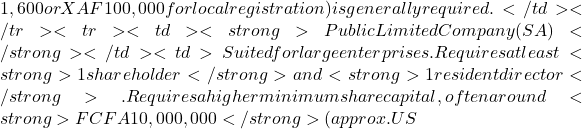 16,000). 16,000). |
| Branch Office (Succursale) | An extension of a foreign company, not a separate legal entity. Must appoint a resident authorized representative. Can operate for a maximum of two years, after which it must be converted into a local limited company (SARL or SA). |
| Representative Office (Bureau de Liaison) | Not a legal entity and is not permitted to conduct direct sales. Generally used for market research or liaison activities. |
Note: It is highly advisable to consult with a local corporate attorney or a legal service firm to select the best structure and manage the registration process.
3. Business Registration Procedure (RCCM)
The government’s Business Creation Formality Centers (CFCE), often located within the Ministry of Small and Medium-Sized Enterprises, are the main one-stop-shops to facilitate the registration process.
General Steps:
- Name Search and Reservation: Check the availability of your proposed company name.
- Document Drafting: Prepare your company’s documents, including the Articles of Association and a Notarial Statement of Subscription and Payment of Share Capital.
- Capital Deposit: Deposit the minimum required share capital in a local bank.
- Notarization: Have certain documents, like the Articles of Association, notarized by a Notary Public.
- Filing at the CFCE/RCCM: Submit all required documents (business plan, proof of capital, identification, business location plan, non-conviction certificates/declaration) to the CFCE.
- Obtain Certificates: Receive the Attestation of Business Registration, the Taxpayer Card, and the Attestation of Business Creation.
- Post-Registration: Register with the tax authority and the National Social Insurance Fund (NSIF).
Foreign Staff and Permits:
Foreign staff who will be working and residing in Cameroon must obtain an Expatriate Quota, a Work Permit, and a Residence Permit.
4. Master Cameroonian Business Culture and Etiquette
Business in Cameroon is highly relationship-oriented. Patience, respect, and building personal connections are vital for success.
| Aspect | Etiquette and Practice |
| Relationships | Building trust and personal rapport is paramount before formal business discussions begin. Decisions often take time, as consensus and hierarchy are respected. Patience and persistence are essential. |
| Communication | Communication is generally indirect, especially when conveying negative feedback. Face-to-face meetings are highly valued for building rapport. |
| Greetings | Formal greetings are important. Shake hands firmly with men and women. Always start by greeting the most senior person first. Take time for pleasantries (asking about family, well-being) before diving into business. |
| Formality & Dress | Dress formally (business suits) for meetings to show respect. Use formal titles (“Monsieur,” “Madame”) unless invited to use first names. Respect for seniority and age is deeply ingrained. |
| Language | French and English are the official business languages. French is the dominant language in business. Knowing basic phrases in French can be beneficial. |
| Punctuality | While punctuality is expected for formal meetings, be prepared for the meeting itself to start later than scheduled. |
5. Key Challenges to Be Aware Of
While the government has introduced reforms, be prepared to manage certain challenges:
- Bureaucracy: Administrative procedures can be slow and complex. Hiring experienced local legal counsel is highly recommended.
- Infrastructure: Issues with infrastructure and power supply can sometimes impact operations.
- Regulatory Changes: The tax and regulatory regime can evolve rapidly, requiring you to stay informed.
Disclaimer: This information is for general guidance only. It is strongly recommended that you seek professional advice from local legal, tax, and corporate experts before initiating any business activities in Cameroon.
