Doing business in Angola requires a strategic approach that navigates a challenging but potentially rewarding market.
Success hinges on understanding the oil-dependent economic structure, the government’s push for diversification, adherence to specific legal requirements for foreign companies, and mastery of Angolan business etiquette.
Business Environment: Opportunities and Challenges
Angola presents a complex business landscape. While rich in resources and boasting a large market size, it is known as one of the most challenging environments globally.
Key Opportunities
- Economic Diversification: The Angolan government is actively pursuing economic diversification away from its heavy oil dependence (which still accounts for over 90% of exports). This opens up opportunities in non-oil sectors.
- Targeted Investment Sectors: Priority sectors for investment include:
- Agriculture and Agro-Processing: Vast fertile land and water resources, with a national drive to reduce reliance on food imports.
- Mining: Untapped mineral resources beyond oil and diamonds (e.g., gold, platinum, iron).
- Infrastructure: Significant need for investment in public-private partnerships (PPPs) for ports, railroads, energy, and water.
- Energy: Strong government commitment to renewable energy (solar and hydro) to reach a 70% installed capacity by 2025.
- Health and Education: Growing demand for quality services, hospital infrastructure, and technical/vocational training.
- Government Reforms: The government has enacted reforms, including a new Private Investment Law (eliminating the mandatory 35% local partner stake in most sectors and reducing capital requirements) and anti-corruption efforts, aimed at improving the investment climate.
- Privatisation Program (PROPRIV): The state is privatizing numerous companies across aviation, insurance, telecommunications, agriculture, and hospitality, creating investment avenues.
Primary Challenges
- Oil Dependency and Volatility: The economy and fiscal revenues are highly sensitive to global oil price fluctuations, creating macroeconomic instability.
- Suboptimal Business Environment: Despite reforms, the environment remains challenging due to heavy bureaucracy, high operating costs (though costs in Luanda have somewhat decreased recently), and difficulties with access to credit.
- Infrastructure Deficiencies: Inadequate infrastructure stock is a key obstacle to diversification and economic growth outside major urban centers.
- Skills Gap: There is a significant mismatch in workforce skills, with a large share of under-skilled workers who may lack the necessary expertise for non-oil sector growth.
- Corruption Concerns: The prevalence of corruption remains a concern for many investors, despite government efforts to increase transparency.
- Language Barrier: Portuguese is the official language, and professional interpretation support is often required outside the oil industry.
Establishing a Business Presence
Foreign investors have several options for establishing a business in Angola, each with distinct legal and capital requirements.
Business Structures
The most common structures for foreign investors are:
| Business Structure | Key Features for Foreigners | Minimum Capital |
| Limited Liability Company (LLC) / Lda | Most preferred structure. Requires a minimum of 1 director and 2 shareholders. Shares are distributed, with shareholders liable up to their investment amount. | US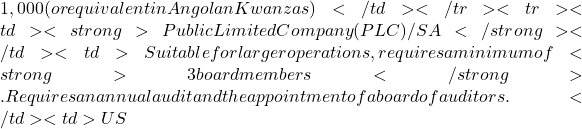 20,000 (30% must be paid up before incorporation) 20,000 (30% must be paid up before incorporation) |
| Branch Office (Sucursal) | An extension of the parent company; not a separate legal entity. Requires appointing a local resident as a representative. Liabilities are unlimited. | No minimum capital requirement |
| Employer of Record (EOR) | An alternative for quick market entry; allows you to hire employees legally without establishing a local entity. The EOR handles payroll and compliance. | Not applicable |
Registration Process for a New Company
The standard registration process involves several key steps, primarily handled through the National Institute of Support to Small and Medium-Sized Companies (INAPEM):
- Choose Business Structure: Select the appropriate legal entity (LLC, PLC, etc.).
- Reserve Company Name: Apply for a name clearance certificate from INAPEM.
- Prepare Documentation: Gather essential documents, which typically include:
- Articles of Association (or similar foundational documents).
- Name clearance certificate.
- Identification (passport, proof of address) for directors and shareholders.
- Proof of a registered office in Angola.
- Tax Identification Number (TIN) application.
- Submit and Register: Submit the documents to INAPEM (either online or in-person).
- Open a Corporate Bank Account: A local account is required for transactions and tax payments.
- Register for Taxes: Mandatory registration for Corporate Tax, VAT (if applicable), and Payroll Taxes/Social Security.
Note: Engaging a qualified local legal or consultancy firm is highly advisable due to the complexity and lengthy nature of the process.
Legal & Regulatory Compliance
Foreign companies must adhere to strict Angolan tax and labor laws, particularly the principle of “Angolanisation.”
Tax Law
| Tax Type | Standard Rate | Details |
| Corporate Income Tax (Industrial Tax) | 25% | Applied to worldwide income, though reduced or increased rates may apply based on the specific activity or tax benefits granted under the Private Investment Law (PIL). |
| Withholding Tax (WHT) on Services | 6.5% | Applied to payments for services provided by tax-resident entities in Angola. |
| Definitive WHT on Services | 15% | Applied to payments for services provided by non-tax resident entities without a permanent establishment in Angola. |
| Value Added Tax (VAT) | 14% | The standard sales tax rate. |
| Capital Income Tax | 5% to 15% | Levied on Angola-source income such as loan interest, royalties, and shareholder profits. |
Labor Law for Foreign Companies
The “Angolanisation Principle” governs foreign employment:
- Workforce Quota: Companies with five or more employees must employ a minimum of 70% Angolan citizens and a maximum of 30% foreign non-residents.
- Foreign Employment Contracts: Foreign non-resident employees can only be hired on fixed-term contracts (typically 3 to 36 months) for positions where local expertise is lacking.
- Working Hours and Leave:
- Standard maximum work week is 44 hours (8 hours/day). Overtime is limited to 2 hours/day, 40 hours/month, and 200 hours/year.
- Employees are entitled to a minimum of 22 working days of paid annual leave.
- Social Security Contributions:
- Employer Contribution: 8.00% of the employee’s gross monthly remuneration.
- Employee Contribution: 3.00% of the gross monthly remuneration.
- Income Tax (Employee): Withholding is progressive, ranging from 10% to 25% of the employee’s salary.
- 14th-Month Salary: Labor law often prescribes a Christmas bonus (commonly a 50% 14th-month salary equivalent).
Business Culture and Etiquette
Building trust and personal relationships is paramount to business success in Angola.
Relationship Building
- Invest Time: Angolans prefer to deal with people they know and trust. Be prepared to spend time on relationship building before discussing business specifics, which may involve initial meetings where little to no business is discussed.
- Hierarchy and Respect: Angolan business culture is highly hierarchical. Decisions are typically made top-down. Always greet and address the highest-ranking individual first.
- Inquire About Family: Inquiring about a business associate’s family is a common sign of respect and an important way to build rapport.
Communication Style
- Formal and Diplomatic: Business discussions should be conducted in a diplomatic and respectful manner. Patience is a virtue, as negotiations and decision-making processes can be slow, often involving multiple rounds of discussion.
- Indirect Communication: Communication is often indirect. Pay close attention to non-verbal cues and unspoken messages. Avoid direct contradiction or public criticism, as this can cause loss of face.
- Language: Portuguese is the official language. While some businesspeople speak English, having written materials in Portuguese and hiring a professional interpreter for meetings is highly recommended.
Etiquette and Dress
- Greetings: A formal handshake is the customary greeting for introductions.
- Dress Code: Formal and conservative attire is standard for business meetings. A suit and tie for men and a professional suit or dress for women is expected, especially in high-level meetings.
- Punctuality: While punctuality is valued for foreign visitors, be prepared for local meetings not to start on time. Show flexibility and understanding while always striving to be on time yourself.
- Business Cards: Exchange business cards by presenting and receiving them with both hands to show respect.
