- Global Presence: The Big Mac is available in thousands of McDonald’s restaurants across over 100 countries worldwide. McDonald’s itself is the largest restaurant chain globally by revenue.
- The Big Mac Index (2025): Developed by The Economist, this index compares the price of a Big Mac in various countries (converted to USD) to gauge purchasing power parity and currency valuation. It’s an economic indicator, not a direct market share metric.
- Example (US): Average cost around
 8.07 in Switzerland,
 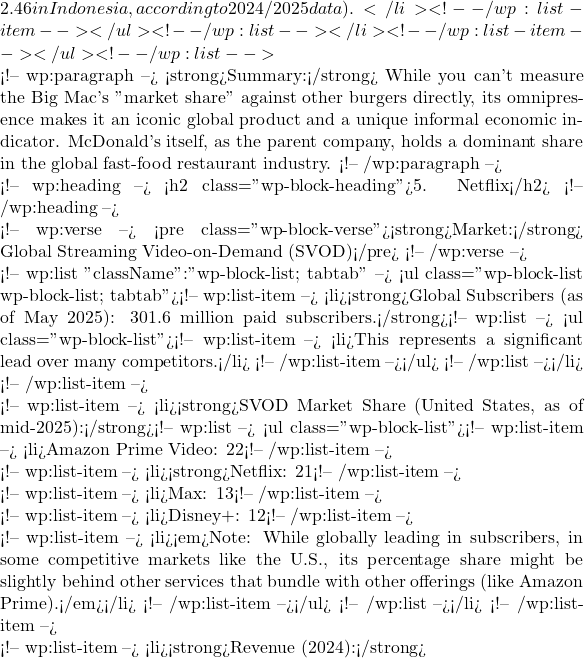 39 billion (projected to
 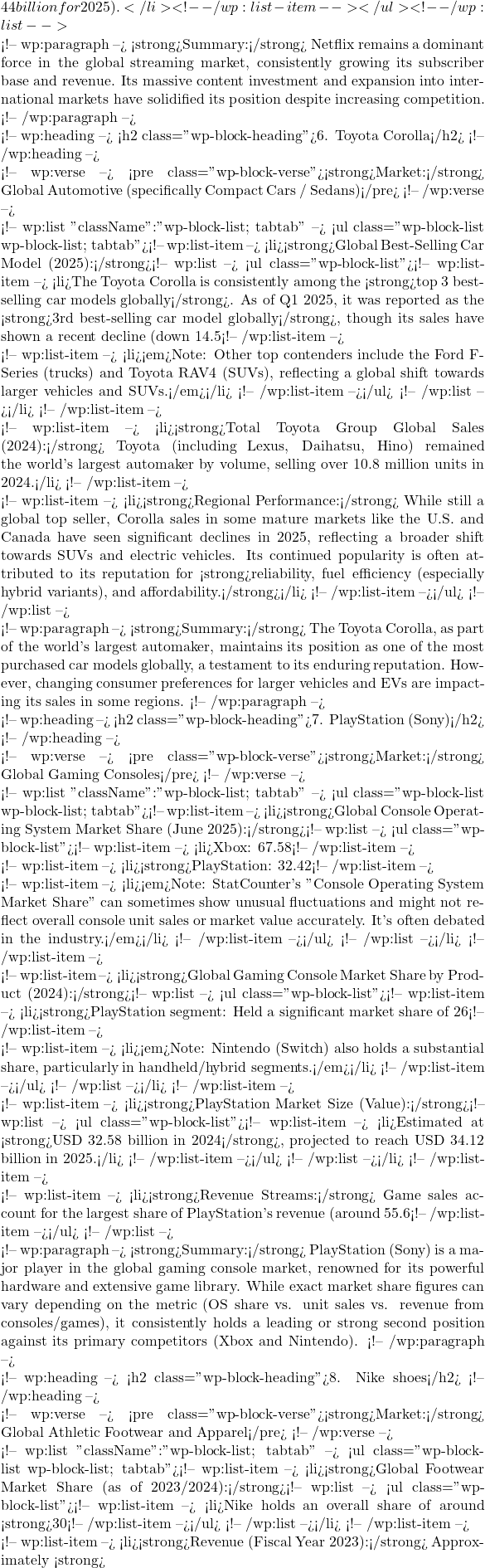 51.217 billion USD.
 - Brand Value (Interbrand, 2024): Nike is consistently ranked among the most valuable global brands.
Summary: Nike is the dominant leader in the global athletic footwear and apparel industry. Its strong brand recognition, extensive product lines, innovative designs, and massive marketing investments (including athlete endorsements) have allowed it to maintain a commanding market share despite increasing competition from brands like Adidas, Puma, and emerging direct-to-consumer players. Recent reports indicate some revenue challenges in late 2024 for their fiscal year, but their overall market leadership remains intact.
Market share data is dynamic. The figures provided are based on the most recent available information (mostly 2024 and early 2025) and are subject to change. Different research firms may also report slightly different figures due to variations in their methodologies.
Gathering precise, real-time “global market share” data for every popular product is challenging, as these figures are constantly fluctuating and often proprietary.
However, here is a general overview based on the latest available information (primarily for 2024 and early 2025 where available), focusing on their dominant positions and the metrics typically used.
* It's important to distinguish between market share by units shipped/sold (volume) and market share by revenue (value), as these can differ significantly, especially for premium products.1. iPhone (Apple)
Market: Global Smartphone Market
- Overall Smartphone Operating System Share (June 2025):
- iOS (Apple): 25.39%
- Android: 74.26%
- Note: This is for the operating system, which largely corresponds to iPhone (iOS) and other brands (Android).
- Global Smartphone Vendor Shipments (2024):
- Apple: Led global device shipments with 232.1 million units.
- Samsung: 223.4 million units.
- Global Smartphone Brand Market Share (October 2024):
- Apple: 28.38%
- Samsung: 22.82%
- Xiaomi: 10.62%
- U.S. Smartphone Market Share (2024):
- iOS (Apple): 57.97% (significantly higher in the US compared to global)
- Android: 41.77%
Summary: Apple’s iPhone consistently holds a significant global market share, particularly in terms of value and in specific markets like the U.S. While Android dominates in overall unit shipments due to the vast number of manufacturers and price points, the iPhone remains a powerful player in the premium segment and commands a substantial portion of app revenue.
2. Coca-Cola (The Coca-Cola Company)
Market: Global Non-Alcoholic Ready-to-Drink (NARTD) Beverages, specifically Carbonated Soft Drinks (CSD).
- Overall Non-Alcoholic Beverage Industry (as of mid-2023):
- The Coca-Cola Company has been reported to hold approximately 42% of the global market share in the non-alcoholic beverage industry, encompassing its vast portfolio of over 500 brands across 200 countries.
- Sparkling Soft Drinks (2024 Value Share – internal estimates):
- The Coca-Cola Company (TCCC) has >50% value share in this category, indicating a dominant position for its flagship Coca-Cola brand and variants (Diet Coke, Coke Zero, etc.).
- U.S. Carbonated Soft Drinks Market Share (as of mid-2022):
- Coca-Cola: 44.9%
- Pepsi: 25.9%
Summary: Coca-Cola is a global behemoth in the beverage industry, particularly in carbonated soft drinks, where it holds a dominant market share. Its vast portfolio and extensive global distribution network ensure its leading position across various beverage segments.
3. Microsoft Windows
Market: Global Desktop Operating Systems
- Overall Operating Systems (all device types, March 2025):
- Android: 46%
- Windows: 25%
- iOS: 18%
- macOS: 6%
- Note: This includes mobile devices, where Android and iOS dominate.
- Desktop Operating System Market Share (June 2025):
- Microsoft Windows: ~71-72%
- macOS (Apple): ~15-16%
- Linux: ~4-5%
- ChromeOS: ~2%
- Desktop Windows Version Market Share (June 2025):
- Windows 10: 48.89%
- Windows 11: 47.83%
- Note: Windows 11 has been steadily gaining on Windows 10, particularly in early 2025, driven by the approaching end of Windows 10 support in October 2025.
Summary: Microsoft Windows remains the undisputed leader in the global desktop operating system market, powering the vast majority of personal computers worldwide. While Windows 10 has historically held the largest share, Windows 11 is rapidly catching up as users upgrade.
4. Big Mac (McDonald’s)
Market: Global Fast Food (specifically Hamburgers), and as an Economic Indicator.
The Big Mac doesn’t have a traditional “market share” in the same way as products sold by multiple companies. It’s a single product from McDonald’s. Instead, its “global presence” is usually discussed in terms of its availability and its role in The Big Mac Index.
- Global Presence: The Big Mac is available in thousands of McDonald’s restaurants across over 100 countries worldwide. McDonald’s itself is the largest restaurant chain globally by revenue.
- The Big Mac Index (2025): Developed by The Economist, this index compares the price of a Big Mac in various countries (converted to USD) to gauge purchasing power parity and currency valuation. It’s an economic indicator, not a direct market share metric.
- Example (US): Average cost around 8.07 in Switzerland, 39 billion (projected to 51.217 billion USD.
- Brand Value (Interbrand, 2024): Nike is consistently ranked among the most valuable global brands.
Summary: Nike is the dominant leader in the global athletic footwear and apparel industry. Its strong brand recognition, extensive product lines, innovative designs, and massive marketing investments (including athlete endorsements) have allowed it to maintain a commanding market share despite increasing competition from brands like Adidas, Puma, and emerging direct-to-consumer players. Recent reports indicate some revenue challenges in late 2024 for their fiscal year, but their overall market leadership remains intact.
Market share data is dynamic. The figures provided are based on the most recent available information (mostly 2024 and early 2025) and are subject to change. Different research firms may also report slightly different figures due to variations in their methodologies.
- Example (US): Average cost around
- Example (US): Average cost around
Global Market Shares of Popular Products

I am the Founder and Editor-in-Chief of the SuperBusinessManager.com website. I am the EU citizen with approximately 20 years of experience in secondary and higher business education in both public and private sectors. Currently living with my wife and our two adorable children in China where I teach Business Management and Economics at K-12 international schools. Professionally, I am an experienced Lecturer and Researcher in Business Management and Economics, as well as IB Examiner for DP Business Management at International Baccalaureate (IB). Privately, I enjoy reading and collecting books on business management, personal finance and investing. You can contact me at jerrygrzegorzek@hotmail.com