The contemporary business landscape is undergoing a fundamental transformation in the way human intelligence interacts with technological systems. For decades, the benchmark for organizational readiness was digital literacy—the foundational ability to engage with digital tools to accomplish everyday tasks responsibly.
However, as the global digital economy is projected to reach US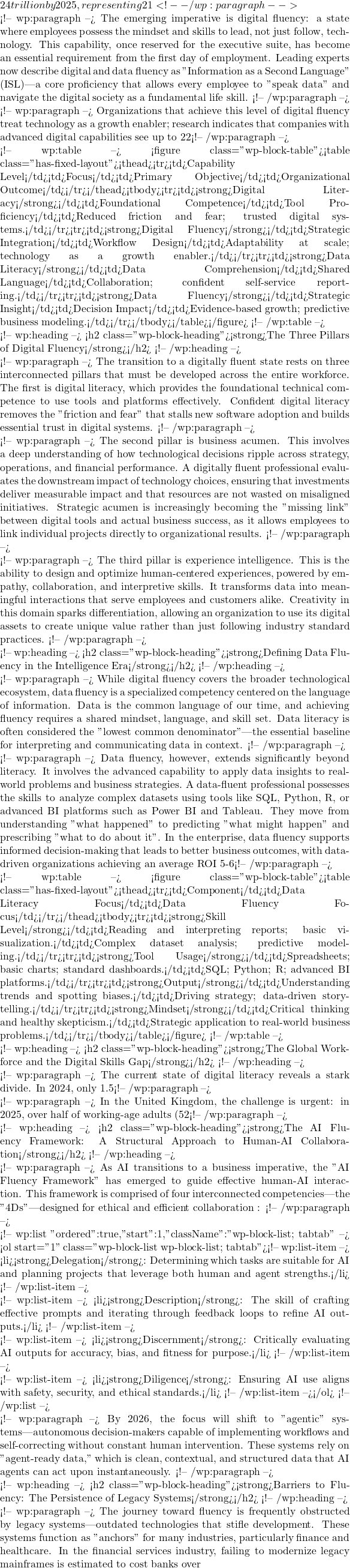

The technical impact of legacy debt is measurable: systems with outdated architectures deliver updates 40% slower than modern systems, creating massive bottlenecks in “change velocity”. Furthermore, nearly 60% of healthcare CIOs cite traditional systems as the single biggest obstacle to their digital transformation efforts.
| Industry | Legacy Obstacle | Impact on Fluency | Modernization Strategy |
| Financial Services | COBOL mainframes. | 40% slower update velocity. | Phased cloud migration. |
| Manufacturing | Early 2000s PLCs and ERPs. | Difficulty interpreting IoT data. | IoT dashboards & modular platforms. |
| Healthcare | Fragmented EHR systems. | Limited care coordination. | Cloud-native EHR & Zero Trust. |
The Human Factor: Overcoming Resistance to Digital Change
The failure of digital transformation is primarily because organizations lack the fluency to integrate technology into human workflows. Resistance is often rooted in “negativity bias”—the brain’s tendency to pay 3x more attention to potential negative outcomes than benefits. Employees resist change due to fear of the unknown, loss of control, and perceived loss of self-efficacy.
Leadership strategies must address the emotional side of change. Transparent communication has been shown to activate the brain’s reward centers, increasing engagement. One of the most effective ways to drive engagement is through gamification. By integrating points, badges, and leaderboards, giants like Cisco and Deloitte have transformed routine training into interactive experiences that boost completion rates and skill acquisition.
Case Studies: The Measurable Impact of Fluency
Clorox: Integrated generative AI into marketing, reducing the generation of assets from weeks to just hours.
Carlyle Group: Over 90% of staff adopted AI tools within one year, leading to a 50% reduction in legal invoice review time.
UPS: Scaled automation to reduce late packages and increase Net Promoter Scores (NPS).
Agentic Pilots: Early enterprises piloting agentic systems report a 30–50% reduction in manual operational workloads.
The Roadmap to 2026: Trends and Future Outlook
The landscape of 2026 will be defined by “agentic enterprises” where human employees and intelligent AI agents work together seamlessly. Key trends include:
- Agentlakes: Composible agent architectures that manage and orchestrate fractured AI deployments across the enterprise.
- Agentic Analytics: AI systems that autonomously write queries, run visual analyses, and flag outliers in minutes.
- Predictive Interfaces: Customer journeys becoming predictive rather than reactive, with AI taking the initiative in discovery and decision-making.
- Digital Product Passports: New regulations requiring manufacturers to disclose detailed lifecycle data for sustainability compliance.
Strategic Recommendations for Leadership
- Fix the Data Plumbing: Prioritize “agent-ready data” (clean, structured, and contextual) as 72% of enterprises currently cite poor data readiness as their biggest obstacle to AI adoption.
- Establish One Governance Model: Define a cross-functional board to set rules, decision rights, and autonomy limits for AI agents.
- Mandate AI Literacy Training: 30% of large enterprises are expected to mandate AI training by 2026 to improve their “Artificial Intelligence Quotient” (AIQ) and reduce risk.
- Adopt the Three Horizons Model: Balance maintaining core operations (Horizon 1) with exploring adjacent innovations (Horizon 2) and investing in disruptive initiatives (Horizon 3).
- Audit for “Agentic Readiness”: Regularly review lead flows, conversion paths, and data accuracy to ensure the digital foundation can support autonomous agents.

