In the world of business, understanding the relationship between cost, volume, and profit is critical to long-term success.
Whether you’re launching a new product, pricing services, or preparing for scaling, making the right financial decisions depends on a clear grasp of how money moves in and out of your business.
That’s where Cost-Volume-Profit (CVP) analysis comes in—a powerful management accounting technique that simplifies complex financial relationships to help you make smarter, faster decisions.
In this post, we’ll explore CVP analysis in detail, covering its purpose, components, formulas, assumptions, practical examples, and limitations. Let’s dive in.
What Is Cost-Volume-Profit (CVP) Analysis?
Cost-Volume-Profit (CVP) analysis is a quantitative tool used by managers to understand how changes in costs, sales volume, and product pricing impact operating profit.
It is widely used in:
- Break-even analysis
- Pricing decisions
- Product mix optimization
- Budgeting and forecasting
The goal of CVP is to assist decision-makers in planning future activities by answering questions like:
How many units do we need to sell to break even?
How will changes in price affect our profitability?
What’s the impact of cost increases on our bottom line?
The Five Core Components of CVP Analysis
CVP analysis revolves around five key variables:
| Component | Description |
|---|---|
| Selling Price (SP) | Price at which each unit is sold. |
| Variable Costs (VC) | Costs that change with production volume (e.g., raw materials, packaging). |
| Fixed Costs (FC) | Costs that remain constant regardless of output (e.g., rent, salaries). |
| Sales Volume (Q) | Number of units sold. |
| Profit | The financial gain (Revenue – Total Costs). |
Core CVP Formula
The basic CVP equation looks like this:
Profit = (Selling Price × Quantity) – (Variable Cost × Quantity) – Fixed Costs
This can be rearranged as:
Profit = Contribution Margin × Quantity – Fixed Costs
Where:
Contribution Margin (CM) = Selling Price – Variable Cost
This margin tells us how much money is left from each unit sale after covering variable costs, which contributes to covering fixed costs and generating profit.
CVP Analysis Tools and Concepts (With Formulas)
1. Break-Even Point (BEP)
The Break-Even Point is the sales volume at which total revenue equals total costs, resulting in zero profit or loss.
Formula (in units):
Break-Even Point (Units) = Fixed Costs / Contribution Margin per Unit
Formula (in dollars):
Break-Even Sales (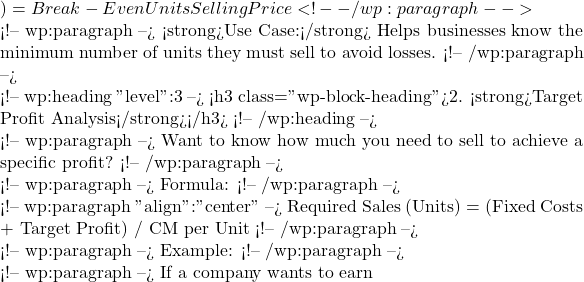 15,000 in profit and has fixed costs of
  20:
20:
( 15,000) /
 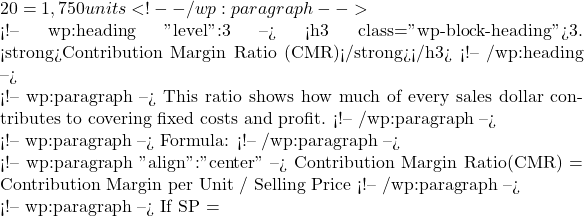 50, VC =
  20 → CMR =
  50 = 0.4 or 40%
This means 40% of each dollar of sales is available to cover fixed costs and profit.
4. Margin of Safety
This tells you how much sales can drop before you start incurring losses.
Formula:
Margin of Safety (%) = (Actual Sales – Break-Even Sales) / Actual Sales × 100
Example:
If actual sales =  75,000:
( 75,000) /
 ![100,000 × 100 = 25% <!-- /wp:paragraph --> <!-- wp:paragraph --> So the business can afford a 25% drop in sales before reaching break-even. <!-- /wp:paragraph --> <!-- wp:heading {"level":3} --> <h3 class="wp-block-heading">5. <strong>Operating Leverage</strong></h3> <!-- /wp:heading --> <!-- wp:paragraph --> Operating leverage measures how sensitive net operating income is to changes in sales volume. <!-- /wp:paragraph --> <!-- wp:paragraph --> Formula: <!-- /wp:paragraph --> <!-- wp:paragraph {"align":"center"} --> Degree of Operating Leverage = Contribution Margin / Net Operating Income <!-- /wp:paragraph --> <!-- wp:paragraph --> A higher operating leverage means profits will rise faster with increased sales—but losses will also deepen with declining sales. <!-- /wp:paragraph --> <!-- wp:separator --> <hr class="wp-block-separator has-alpha-channel-opacity"/> <!-- /wp:separator --> <!-- wp:html --> <script async src="https://pagead2.googlesyndication.com/pagead/js/adsbygoogle.js?client=ca-pub-3196649779609103" crossorigin="anonymous"></script> <!-- Inside Content --> <ins class="adsbygoogle" style="display:block" data-ad-client="ca-pub-3196649779609103" data-ad-slot="4855547878" data-ad-format="auto" data-full-width-responsive="true"></ins> <script> (adsbygoogle = window.adsbygoogle || []).push({}); </script> <!-- /wp:html --> <!-- wp:separator --> <hr class="wp-block-separator has-alpha-channel-opacity"/> <!-- /wp:separator --> <!-- wp:heading --> <h2 class="wp-block-heading">Practical Example: Applying CVP in Business</h2> <!-- /wp:heading --> <!-- wp:paragraph --> Scenario: <!-- /wp:paragraph --> <!-- wp:paragraph --> A tech startup is selling smart thermostats at](https://www.SuperBusinessManager.com/wp-content/ql-cache/quicklatex.com-f4b2ae6e534a54139221d48a8f204641_l3.png "Rendered by QuickLaTeX.com") 200 per unit. The variable cost per unit is
200 per unit. The variable cost per unit is  40,000.
Step 1: Contribution Margin:  120 =
120 =  40,000 /
  20,000 Profit: (
 20,000) /
  20,000 profit.
Assumptions of CVP Analysis
CVP analysis is powerful, but it relies on several simplifying assumptions:
- Linear revenue and cost behavior: Price and variable cost per unit remain constant.
- All costs are classified as either fixed or variable—no mixed costs.
- Inventory levels remain constant—what you produce, you sell.
- Product mix is constant (in case of multiple products).
- Relevant range is not exceeded—fixed costs don’t change abruptly at certain volumes.
These assumptions make CVP most effective for short-term and single-product decision-making.
When to Use CVP Analysis?
| Decision Scenario | How CVP Helps |
|---|---|
| Launching a new product | Identifies break-even and pricing strategy |
| Considering a cost increase | Shows how price or volume must change to maintain profit |
| Evaluating marketing campaigns | Predicts volume needed to recover campaign costs |
| Expanding production | Measures risk and required volume to cover new fixed costs |
| Comparing product lines | Analyzes contribution margin across multiple products |
Limitations of CVP Analysis
Despite its usefulness, CVP has limitations:
- Oversimplification: Real-world costs are often mixed, not purely fixed or variable.
- Static pricing: Prices can fluctuate with competition, market demand, or volume.
- Ignores capacity constraints: Doesn’t account for labor limits or machine hours.
- Assumes constant efficiency: Ignores learning curves or productivity changes.
- Not ideal for long-term decisions: Better suited for tactical planning, not strategic forecasting.
Pro Tips for Using CVP Effectively
Always validate assumptions with current data.
Use CVP in conjunction with scenario planning to test “what-if” cases.
Combine CVP with sensitivity analysis to understand risks.
Update your CVP model regularly—cost structures can change quickly.
Final Thoughts
Cost-Volume-Profit (CVP) Analysis is a foundational tool in the financial toolkit of any business leader.
By breaking down how costs and sales interact, CVP helps you make smarter pricing, budgeting, and expansion decisions—without guesswork.
Whether you’re a small business owner, a financial analyst, or a product manager, mastering CVP analysis gives you the insight needed to grow your business with confidence.

Comments are closed.