In modern industrial strategy and product engineering, innovation rarely requires rebuilding an entire commercial product or ecosystem from the ground up. Instead, many of the most significant advances in performance, cost efficiency, and market share stem from component innovation.
Also known as modular innovation within classic management theory, component innovation involves making fundamental technological breakthroughs in a core subsystem, module, or underlying material while maintaining the overarching product architecture and system design.
By isolating technological advances to high-impact components, enterprise leaders can dramatically enhance customer value without forcing costly redesigns of the broader platform, supply chain, or end-user interface. This strategic model allows specialized suppliers and system integrators to capture extraordinary financial returns, construct formidable intellectual property moats, and control critical bottlenecks in global value chains.
This article examines the theoretical foundations of component innovation, analyzes its strategic benefits, evaluates real-world enterprise case studies across global markets, and outlines executive considerations for managing modular technological strategy.
The Theoretical and Strategic Framework of Component Innovation
The Henderson-Clark Innovation Model
The concept of component innovation was formalized in technological strategy by Rebecca Henderson and Kim Clark through the Henderson-Clark Innovation Framework. The model distinguishes technological knowledge along two core dimensions:
- Component Knowledge: Understanding the underlying core design concepts, chemical properties, physics, or software embedded within a specific sub-unit or module.
- Architectural Knowledge: Understanding how individual components are linked together into a coherent, functioning system.
| Innovation Type | Core Component Technology | System Architecture & Linkages | Primary Objective |
| Incremental Innovation | Reinforced / Minor Tweak | Unchanged | Refine existing performance and cost efficiency. |
| Component (Modular) Innovation | Overhauled / Novel | Unchanged | Breakthrough in module capability without altering system layout. |
| Architectural Innovation | Unchanged | Overhauled | Reconfigure existing components into new product form factors. |
| Radical Innovation | Overhauled / Novel | Overhauled | Establish an entirely new product category and operating paradigm. |
Component innovation occurs when a firm introduces a new core design concept for a module while leaving the system architecture intact. For example, swapping a mechanical hard disk’s ferrite read/write head for a thin-film metallic head significantly increased data storage density while leaving the hard drive’s external form factor and interface identical.
Strategic Advantages of Modular Component Advancement
For multinational corporations and component specialists alike, prioritizing component innovation yields strategic advantages:
- Capital Efficiency and Ecosystem Compatibility: Overhauling an entire product architecture requires massive capital expenditure (CapEx), customer re-education, and ecosystem realignment. Component innovation leverages established manufacturing lines, distribution networks, and complementary software, minimizing time-to-market.
- Value Appropriation at Key Bottlenecks: Companies that master a critical, difficult-to-replicate component often capture a disproportionate share of the total industry value pool, transforming themselves into indispensable supply chain anchors.
- Scalable Platform Strategies: A stable product architecture allows enterprises to swap updated components across multiple product lines, realizing significant economies of scale and standardized manufacturing operations.
Global Corporate Case Studies and Financial Impact
Component innovation drives commercial leadership across high-technology, automotive, consumer electronics, and industrial manufacturing sectors worldwide.
Semiconductors and Compute Infrastructure: TSMC, ASML, and Nvidia
The global semiconductor ecosystem is built upon component-level specialization, where individual firms innovate core modules that power modern computing architectures.
- TSMC (Taiwan) and Advanced Packaging: Taiwan Semiconductor Manufacturing Company has maintained its dominant foundry position by innovating at the component level—specifically through advanced chip packaging capabilities like Chip-on-Wafer-on-Substrate (CoWoS). Rather than forcing a complete redesign of silicon architectures, CoWoS connects multiple microchips into a single unified component module. TSMC generated over
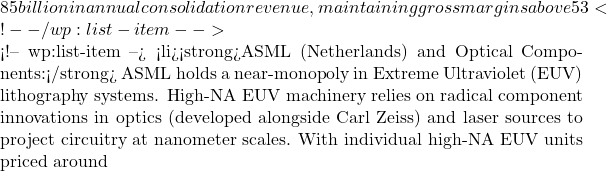
- Nvidia (United States) and Interconnect Technology: Beyond graphics processing architectures, Nvidia’s proprietary NVLink high-speed interconnect component represents a critical module innovation. By allowing multiple GPUs to communicate seamlessly within standard server racks, Nvidia solved the data transfer bottleneck in artificial intelligence cluster computing, securing an estimated 80% to 95% share of the AI hardware acceleration market.

Clean Energy and Mobility: CATL
In the global electric vehicle (EV) sector, Contemporary Amperex Technology Co., Limited (CATL), based in Ningde, China, illustrates the power of component innovation in energy storage.
- Cell-Level and Chemistry Innovation: Rather than building finished electric automobiles, CATL focuses on battery cell chemistry and physical integration components, such as its Qilin battery module and Lithium Iron Phosphate (LFP) advancements. CATL achieved a energy density breakthrough at the battery pack level while maintaining standard EV skateboard platform geometries.
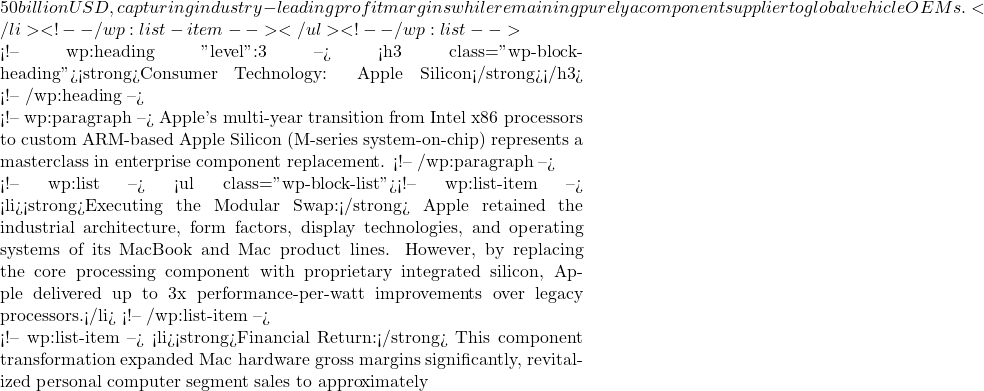
- Financial and Market Metrics: By perfecting cell-level performance and cost efficiency, CATL captured over 37% of the global EV battery market, supplying automakers including Tesla, BMW, Volkswagen, and Ford. CATL generates annual revenues exceeding

Industrial Engineering: Shimano
In the cycling and sports equipment industry, Shimano of Japan exemplifies durable component dominance.
- Drivetrain and Braking Specialization: Shimano develops precision derailleurs, cassette sprockets, electronic shifting (Di2), and hydraulic disk braking components. Bike frames adhere to universal dimensional standards, allowing bicycle manufacturers worldwide to design custom frames while integrating Shimano’s drivetrain components.
- Market Control: Through continuous material and electronic component innovations, Shimano controls an estimated 70% to 80% of the global market for mid-to-high-end bicycle drivetrains, producing high operating margins and building deep brand equity among consumers and OEMs alike.
Strategic Risks and Management Implications
While component innovation offers substantial rewards, reliance on modular strategies carries specific organizational and strategic risks that executive teams must actively manage.
The Threat of Unseen Architectural Shifts
Firms focused exclusively on perfecting a single component risk blinding themselves to fundamental shifts in product architecture. For example, legacy mechanical watchmakers invested heavily in improving micro-gear component tolerances, only to be disrupted by quartz and digital smartwatch architectures that rendered traditional mechanical linkages obsolete.
Supplier Hold-Up and OEM Dependency
For original equipment manufacturers (OEMs), delegating core component innovation to specialized suppliers can create supply chain vulnerabilities. When a single supplier achieves a technological monopoly over a key component (e.g., ASML in EUV lithography or Nvidia in AI interconnects), the supplier commands extreme pricing power and margin capture, leaving downstream integrators with diminished profitability.
Intellectual Property Protection
Because component innovation retains standard external interfaces, competitors can often reverse-engineer or substitute alternative components if the underlying technology is not adequately protected. Enterprise leaders must protect component breakthroughs through multi-layered patent thickets, proprietary materials processing, and specialized manufacturing trade secrets.
Conclusion
Component innovation remains one of the most effective strategic levers for achieving sustained competitive advantage in modern technology and manufacturing sectors. By focusing research and development efforts on upgrading core functional modules within established product architectures, organizations can achieve leaps in product performance, optimize capital efficiency, and capture high-margin market positions.
As industries increasingly adopt modular, platform-based business models, the ability to engineer, defend, and commercialize superior components will distinguish market leaders from low-margin assemblers across the global economy.

