The reserve ratio is a key concept in fractional reserve banking and central bank policy, representing the proportion of a bank’s deposits that it must hold in reserve, either in its vault or on deposit with the central bank.
It is a critical metric used by both commercial banks for liquidity management and by central banks (like the Federal Reserve in the US or the European Central Bank) as a monetary policy tool to influence the money supply and credit in an economy.
The Reserve Ratio Formula
The calculation of the reserve ratio is straightforward. It is determined by dividing a bank’s required reserves by its total deposits.
The formula is:
Reserve Ratio = Required Reserves / Total Deposits
Where:
Required Reserves are the minimum amount of funds a bank must legally hold, as mandated by the central bank. This is often a percentage of the bank’s total transaction accounts (deposits).
Total Deposits refers to the value of all customer deposits held by the bank, which serve as the base for the required reserve calculation.
Understanding the Components
To effectively calculate and manage the ratio, banks must precisely identify the required and total deposit figures.
Required Reserves
The central bank sets the reserve requirement (or reserve requirement ratio) as a percentage. This percentage is then applied to a bank’s eligible deposits to determine the dollar amount of required reserves.
For example, if the central bank sets a reserve requirement of 10% and a commercial bank has  100,000,000 =
 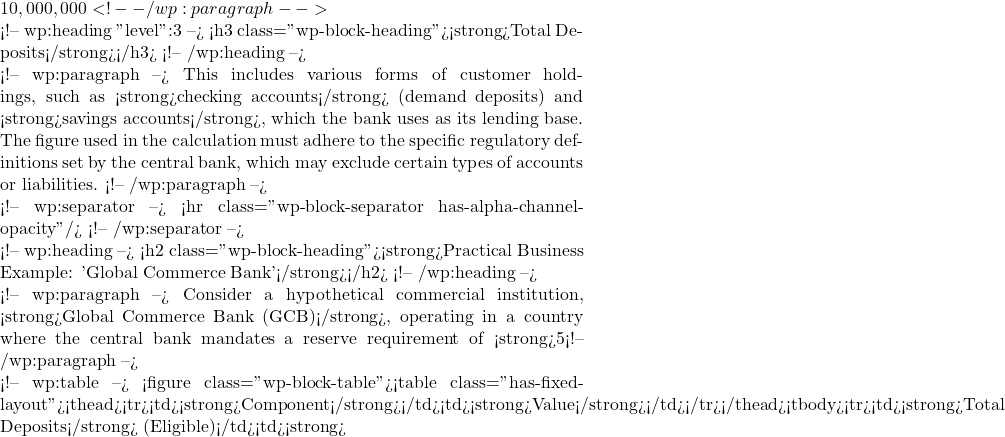 500,000,000
 )
)Step 1: Calculate the Required Reserves
Required Reserves = Total Deposits x Reserve Requirement Ratio
Required Reserves =  25,000,000
Step 2: Calculate the Reserve Ratio
In this highly regulated context, the calculated reserve ratio will ideally match the central bank’s required ratio, but banks may hold excess reserves for operational liquidity.
Assume GCB is currently holding  30,000,000 /
  5 million in excess reserves (
 25 million).
Significance of the Reserve Ratio
Bank Management and Lending Capacity
The reserve ratio directly affects a bank’s profitability and lending capacity. The funds held as reserves do not earn interest for the bank; thus, holding excessive reserves beyond the required minimum can reduce potential profits from lending. However, holding a slightly higher ratio (excess reserves) provides a liquidity cushion against unexpected withdrawals, mitigating the risk of a bank run.
Central Bank Monetary Policy
The reserve requirement is a potent, though rarely used, tool of monetary policy.
- Increasing the Reserve Requirement shrinks the money multiplier and forces banks to hold more money, which decreases their ability to lend. This is a contractionary policy, slowing economic activity.
- Decreasing the Reserve Requirement increases the money multiplier and allows banks to lend more, which expands the money supply. This is an expansionary policy, stimulating economic growth.
For example, as a response to the 2008 financial crisis, the U.S. Federal Reserve, among other central banks, kept reserve requirements low or at zero to encourage lending and support the economy. In March 2020, the Federal Reserve reduced the reserve requirement for all banks to zero percent to ensure maximum liquidity during the pandemic.
Real Business Examples from Around the World
The reserve requirement and the resulting reserve ratio vary significantly across jurisdictions and are actively managed for policy goals.
China’s People’s Bank of China (PBOC): The PBOC frequently adjusts the Reserve Requirement Ratio (RRR) for Chinese banks, using it as an active tool to manage liquidity in the world’s second-largest economy. Raising the RRR often signals an effort to cool down economic overheating or curb excess credit growth. For instance, the PBOC has historically maintained separate, higher RRR levels for larger state-owned commercial banks compared to smaller rural banks to manage systemic risk and promote lending to smaller enterprises.
The Eurozone (European Central Bank – ECB): The ECB has maintained a low minimum reserve requirement for credit institutions in the Eurozone, setting it to 1% in the early 2010s and often keeping it low to stimulate lending and economic activity following periods of crisis and stagnation. The focus of the ECB has largely shifted from reserve requirements to open market operations (buying and selling bonds) as its primary tool for monetary policy, demonstrating the varying reliance on this ratio across central banks.
Australia (Reserve Bank of Australia – RBA): The RBA does not impose a mandatory reserve requirement on commercial banks. Instead, it relies almost exclusively on open market operations to manage the cash rate and influence the financial system. Australian banks still hold reserves, but these are primarily for settling payments and meeting liquidity requirements rather than fulfilling a statutory ratio requirement. This shows that the concept of a mandatory reserve ratio is not universal.
