The Rate of Return (RoR) is a fundamental metric in finance that measures the gain or loss on an investment over a specified period, expressed as a percentage of the initial investment. A positive RoR indicates a profit, while a negative RoR indicates a loss.
There are three main ways to calculate the Rate of Return, depending on the complexity of the investment and the time frame: the Simple Rate of Return, the Rate of Return with Income, and the Compound Annual Growth Rate (CAGR).
1. Simple Rate of Return (Holding Period Return)
The simple Rate of Return (RoR), also known as the Holding Period Return, is the most basic calculation. It is used to find the return on an investment for a single period, without factoring in any periodic income like dividends or interest.
Formula
The basic formula for the Simple Rate of Return is:
RoR = (Current Value − Initial Value) / Initial Value × 100
| Term | Definition |
| Current Value | The investment’s value at the end of the period. |
| Initial Value | The investment’s value at the beginning of the period. |
Real Business Example: Real Estate Investment
A U.S.-based individual investor purchased a vacant commercial plot for  335,000.
Initial Value:  335,000
RoR = ( 250,000) /
  85,000 /
 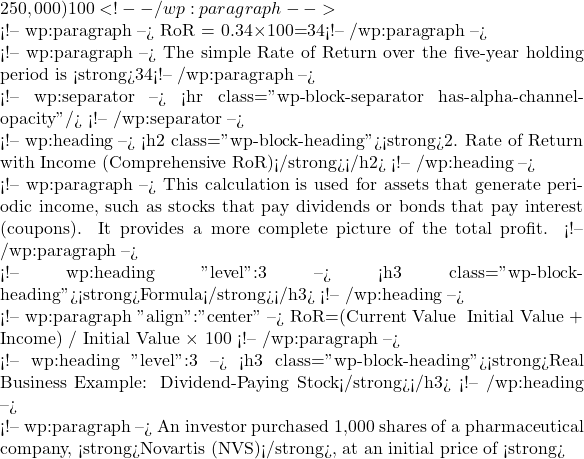 60 per share, making the Initial Value
  10,000 in dividend income. The current value of the shares is
  80,000.
Initial Value:  80,000
Income (Dividends):  80,000 −
  10,000) /
  30,000 / $60,000) × 100
RoR = 0.50 × 100 = 50%
The total Rate of Return on the Novartis investment, including capital appreciation and dividends, is 50%.
3. Compound Annual Growth Rate (CAGR)
When an investment spans multiple years, the simple RoR can be misleading because it doesn’t account for the compounding effect—where earnings from previous periods are reinvested and start earning their own returns. The Compound Annual Growth Rate (CAGR) provides a smoothed, equivalent annual return over the entire period, making it the most useful metric for comparing investments held for different lengths of time.
Formula
CAGR = [(Ending Value / Beginning Value) 1/n −1] × 100
| Term | Definition |
| Ending Value | The investment’s total value at the end of the period (including all accumulated income). |
| Beginning Value | The investment’s total value at the start of the period. |
| n | The number of years the investment was held. |
Real Business Example: Mutual Fund Performance
A retail investor in Germany invested €10,000 in a global equity mutual fund (beginning value) five years ago (n=5). The current value of the investment is €14,000 (ending value).
Ending Value: €14,000
Beginning Value: €10,000
Number of Years (n): 5
CAGR = [(€14,000 / €10,000) 1/5 − 1] × 100
CAGR = [1.0696−1] × 100
CAGR = 0.0696 × 100 ≈ 6.96%
The investment achieved a Compound Annual Growth Rate (CAGR) of approximately 6.96% over the five-year period.
