Calculating Goodwill and Patents involves distinct methods based on how the assets were acquired (purchased versus internally developed) and their nature as intangible assets.
1. Goodwill Calculation
Goodwill is an intangible asset representing the value of a company’s brand reputation, customer base, employee relations, and expected synergies from an acquisition that are not separately identifiable. It is only recognized and calculated in accounting when one company acquires another (a business combination).
The Formula for Goodwill
Goodwill is calculated as the excess of the purchase price over the fair market value of the identifiable net assets acquired.
Goodwill = Purchase Price of the Acquired Company – (Fair Value of Identifiable Assets – Fair Value of Liabilities)
Key Points:
- Identifiable Assets: These are assets that can be separately identified and valued, such as property, plant, and equipment, inventory, accounts receivable, and other identifiable intangible assets like patents and customer lists.
- Fair Value: All identifiable assets and liabilities of the acquired company must be restated to their fair market value at the date of acquisition for this calculation.
- Internally Generated Goodwill: Goodwill created internally (e.g., through years of building a strong brand) is never recognized or capitalized on the company’s balance sheet under accounting standards like GAAP and IFRS, as its cost cannot be measured reliably.
Real Business Example (Goodwill)
When Microsoft acquired LinkedIn in 2016 for approximately 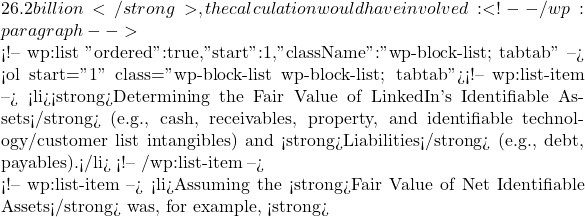 5 billion.
 5 billion (Net Identifiable Assets) =
  21.2 billion represented the premium Microsoft paid for LinkedIn’s non-identifiable value, such as its powerful professional network and market position.
2. Patents Calculation (Valuation Methods)
A patent is an identifiable intangible asset that grants the owner a legal monopoly over an invention for a fixed period. The calculation (or valuation) depends on whether the patent was purchased or internally developed.
1. Cost of a Purchased Patent
When a patent is purchased from another entity, its value is simply its acquisition cost (the purchase price) plus any directly related costs incurred to get the patent ready for its intended use, such as legal fees and registration costs.
2. Cost of an Internally Developed Patent
Accounting standards generally require that all Research and Development (R&D) costs incurred to create the invention itself be expensed as they occur. Only the direct legal and registration fees required to successfully file and obtain the patent can be capitalized (recorded as the patent asset’s cost). The cost of the patent on the balance sheet is typically low compared to its economic value.
3. Patent Valuation Methods
To determine a patent’s true economic worth (e.g., for a sale, licensing, or M&A transaction), professional valuation uses one or more of three main approaches:
A. The Income Approach
This is the most common and often preferred method. It estimates the patent’s value by calculating the present value of the future economic benefits it is expected to generate.
- Discounted Cash Flow (DCF) Method: Estimates the incremental cash flows the patent will generate over its useful life (e.g., increased sales, cost savings) and discounts them back to a present value using an appropriate discount rate (reflecting risk).
- Relief-from-Royalty Method: Calculates the value as the present value of the royalties the company would have to pay to a third party to use the patented technology. This “relief” from paying royalties is the economic benefit.
B. The Market Approach
This method estimates value by comparing the patent to the prices of similar, comparable patents that have recently been sold or licensed in the marketplace. This is often difficult because patents are unique, and comparable transaction data is often scarce.
C. The Cost Approach
This method estimates the value based on the cost to recreate or replace the patented technology (e.g., the cost of R&D, materials, and labor to develop an equivalent patent). This method typically sets the minimum value for a patent, as it doesn’t consider the future income-generating potential.
Real Business Example (Patent Amortization)
A pharmaceutical company in Switzerland, Novartis, might purchase a drug patent for  50 million
Amortization Expense (over useful life):  5 million per year/ Novartis would record $5 million as an annual Amortization Expense on the Income Statement, and the Patent’s carrying value on the Balance Sheet would decrease by the same amount each year.
