The Capitalization Ratio, often used interchangeably with the Debt-to-Capital Ratio, is a financial metric that measures the proportion of a company’s total capital structure that is financed by debt.
It helps investors and analysts assess a company’s financial leverage and solvency risk.
Formula for Capitalization Ratio
The most common formula for the capitalization ratio is to divide a company’s total debt by its total capitalization (the sum of total debt and shareholders’ equity).
Capitalization Ratio = Total Debt / (Total Debt + Shareholders’ Equity)
This ratio is typically expressed as a decimal or a percentage.
Key Components
The necessary figures for this calculation are found on a company’s balance sheet.
- Total Debt: This usually includes both short-term debt (current liabilities like notes payable) and long-term debt (non-current liabilities like bonds payable and long-term bank loans). For risk assessment, analysts focus on interest-bearing debt.
- Shareholders’ Equity: This represents the owners’ residual claim on the assets, calculated as Total Assets minus Total Liabilities. It includes components like common stock, preferred stock, and retained earnings.
Calculation Example
Assume a manufacturing company, Global Auto Parts Co., has the following figures from its balance sheet:
Short-term Debt:  200 million
Shareholders’ Equity: 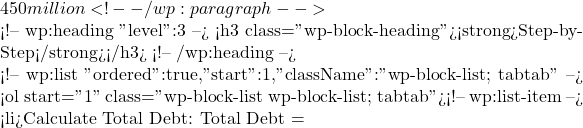 50 million +
  250 million
 450 million =
  250 million / $700 million * 100 = 35.71%
Interpretation
A capitalization ratio of 35.71% indicates that approximately 35.71% of Global Auto Parts Co.’s total capital structure is financed through debt, while the remaining 64.29% is financed by equity.
Business Example and Analysis
The meaning of a “good” capitalization ratio depends heavily on the industry. Companies in capital-intensive industries with stable cash flows, such as utility companies or telecommunications firms, often operate safely with higher capitalization ratios than companies in volatile sectors, such as high-growth technology or cyclical manufacturing.
Example: Telecom GiantsLarge telecommunications companies often carry substantial debt to finance the massive infrastructure (towers, fiber optics) required for their operations.12 While a high ratio might signal risk in other sectors, the stable, recurring revenue from long-term customer contracts helps ensure they can service this debt. An investor would compare this ratio to industry peers like Verizon (US) or Vodafone (UK) to determine if the company’s debt level is within the accepted industry range.
A higher ratio generally indicates higher financial leverage and a potentially greater risk of default, as the company relies more heavily on fixed debt obligations. A lower ratio suggests a greater reliance on equity financing and a lower risk profile.
