Days Sales Outstanding (DSO) is a crucial financial metric that measures the average number of days it takes for a company to collect cash from customers after a credit sale has been made.
A lower DSO is generally better, as it indicates a company is efficiently converting its credit sales into cash, which improves working capital and liquidity.
Calculating Days Sales Outstanding (DSO)
There are two common methods for calculating DSO: the simple method and the more accurate countback method.
1. Simple DSO Method
This is the most common and straightforward formula, useful for high-level trending analysis.
DSO = (Average Accounts Receivable / Net Credit Sales) × Number of Days in Period
Components:
Average Accounts Receivable (A/R): This is typically calculated as (Beginning A/R+Ending A/R)/2. This uses an average to better match the A/R on the balance sheet with the sales on the income statement over the period.
Net Credit Sales (or Revenue): This is the total revenue from sales made on credit during the measurement period. Cash sales are excluded because they have a DSO of zero.
Number of Days in Period: This depends on the period you are measuring (e.g., 365 for a year, 90 or 91 for a quarter, 30 or 31 for a month).
Example Calculation (Annual):
- Beginning Accounts Receivable:
 600,000
 - Net Credit Sales for the Year:
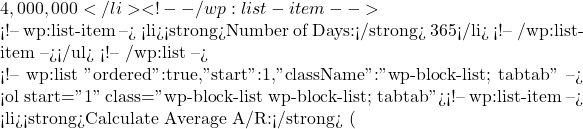 400,000 +
  500,000
 - Calculate DSO: (
 4,000,000) × 365 = 0.125 × 365 = 45.625 days
This means it takes the company an average of about 46 days to collect on a credit sale.
2. Countback Method
The countback method is more complex but more accurate, especially when sales are seasonal or fluctuate significantly. It uses actual sales for each month to determine exactly how many days of sales are represented in the current Accounts Receivable balance.
You count back month by month, using the exact number of days in each month, until the cumulative credit sales cover the current A/R balance.
Interpreting and Benchmarking DSO
A low DSO indicates effective credit policies and collections, leading to better cash flow. A high DSO suggests issues in the collections process, lenient credit terms, or customer credit problems, which ties up capital.
Industry Benchmarks
What constitutes a “good” DSO is highly dependent on the industry and the standard payment terms (e.g., Net 30, Net 60). A healthy DSO should be close to your stated average payment terms.
| Industry | Typical DSO Benchmark (Days) | Factors Affecting DSO |
| Retail/E-commerce | 5 to 20 | High volume, typically cash/card payments. |
| Wholesale Distribution | 30 to 50 | Shorter B2B credit terms. |
| Professional Services | 30 to 60 | Dependent on client size and billing cycles. |
| Manufacturing | 45 to 60+ | Longer production cycles, larger transactions, more lenient B2B terms. |
| Construction | 60 to 90+ | Often based on project milestones and complex contractual payments. |
Real Business Examples of DSO Improvement
Businesses worldwide prioritize reducing DSO to optimize their working capital.
Implementing Automation (Global Example): A large manufacturing company in Germany, which had a high DSO due to decentralized and manual invoicing, implemented an automated Accounts Receivable (A/R) management system. This system streamlined invoice generation, error-checking, and automatic payment reminders, especially for international clients. By cutting down the time and errors in the invoice-to-cash cycle, the company was able to reduce its DSO from an average of 75 days to 58 days within one fiscal year, significantly freeing up cash for reinvestment in R&D.
Strategic Credit Policy (Example in Asia): A B2B electronics distributor in Singapore was struggling with a rising DSO. They implemented a tiered credit policy based on a rigorous, quantitative assessment of customer creditworthiness. They offered early payment incentives (e.g., a 2% discount for payment within 10 days) to their best-rated clients and shortened the standard payment terms for new or higher-risk customers. This strategic adjustment improved their on-time payment rate and helped them achieve a target DSO of 35 days, aligning closely with their Net 30 terms.
