When a company needs to raise capital, it usually faces a stark choice: issue debt and take on interest payments, or issue equity and dilute existing shareholders. However, there is a middle ground that combines the features of both.
Convertible bonds are hybrid financial instruments that start their life as corporate debt but offer the investor the right to convert the bond into a predetermined number of shares of the issuing company’s common stock at specific times.
For corporations, they offer a way to borrow money at below-market interest rates. For investors, they provide the defensive safety of fixed-income regular payments alongside the upside potential of equity markets.
How Convertible Bonds Work: The Mechanics
At its core, a convertible bond behaves exactly like a traditional corporate bond until the investor decides to exercise the embedded conversion option. It pays a regular coupon (interest) and promises to return the principal (par value) at maturity.
To understand the lifecycle of these instruments, investors must track several foundational metrics:
- Par Value: The face value of the bond, typically
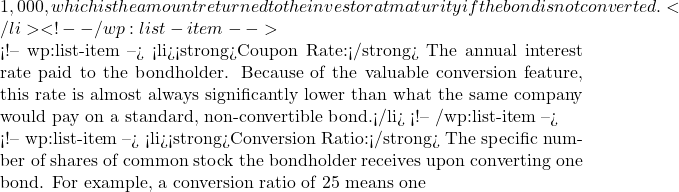 1,000 bond can be exchanged for 25 shares of stock.
 - Conversion Price: The effective price per share at which the bond converts into equity. It is calculated by dividing the par value by the conversion ratio. If the par value is
 40 (
40 (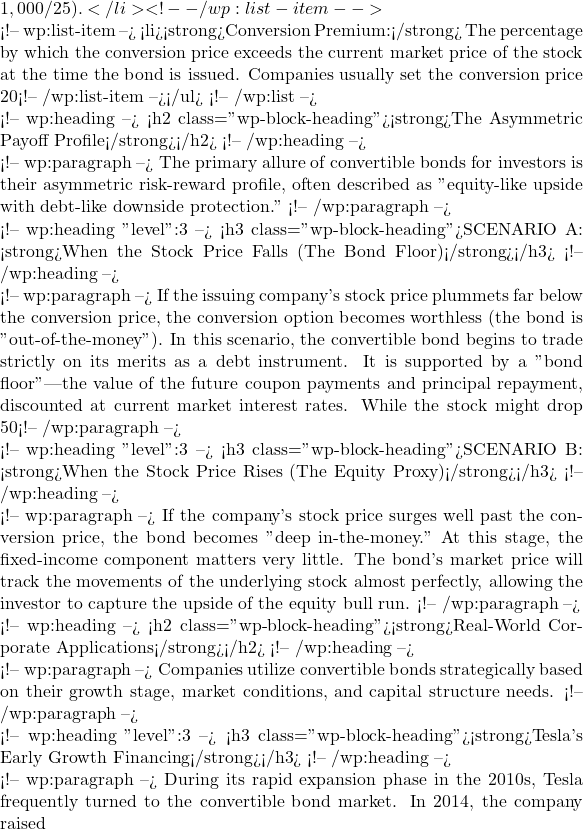 2 billion via convertible notes to fund its Gigafactory construction. High-growth tech and automotive companies use convertibles because their stock is volatile and highly valued, which allows them to offer a low coupon rate (sometimes less than 1%) while investors happily accept the conversion premium, betting on massive future stock growth.
Singapore Airlines’ Pandemic Resilience
In 2020, amidst severe global travel restrictions, Singapore Airlines raised billions through convertible bonds as part of a liquidity preservation strategy. For mature companies facing temporary operational stress, convertible debt allows them to secure emergency funding without immediately diluting their stock at depressed pandemic-era prices, while offering investors protective yields with long-term recovery upside.
MicroStrategy’s Bitcoin Acquisition Strategy
In recent years, enterprise software firm MicroStrategy has repeatedly issued convertible senior notes to aggressively purchase Bitcoin. By utilizing convertible debt, the company secured billions in capital at incredibly low interest rates (often below 1% or even at 0.75% interest). Investors accepted these ultra-low yields because the conversion terms allowed them to ride the explosive upside of the company’s equity, which closely mirrors the price of Bitcoin, while retaining a senior claim on corporate assets if the crypto market collapsed.
Advantages and Disadvantages
For Issuer Corporations
Advantages Disadvantages Lower Cost of Debt: The embedded equity option allows companies to offer significantly lower coupon payments, preserving immediate cash flow. Risk of Dilution: If the company performs exceptionally well, the bonds will convert into shares, diluting the ownership and earnings per share (EPS) of existing stockholders. Delayed Dilution: Equity is issued in the future at a premium price, rather than selling shares immediately at current market rates. Refinancing Risk: If the stock underperforms and the bonds do not convert, the company faces a large cash obligation to repay the principal at maturity. Fewer Restrictive Covenants: Investors are often willing to accept fewer operational restrictions on the company in exchange for the equity upside. Tax Treatment Change: Interest payments are tax-deductible for corporations, but once converted to equity, dividend payments (if any) are not. For Investors
Advantages Disadvantages Downside Mitigation: The contractual right to interest payments and principal return creates a price floor that limits losses if the company fails to grow. Lower Yields: Investors sacrifice current income compared to traditional corporate bonds issued by the same organization. Capital Appreciation: Allows fixed-income investors to participate in explosive stock market rallies without purchasing volatile equities directly. Call Risk: Many convertible bonds feature a call provision allowing the corporation to force conversion or redeem the bonds early if the stock hits a target price, cutting short the investor’s upside. Seniority over Common Stock: In the event of corporate liquidation or bankruptcy, bondholders are paid out before equity holders. Liquidity Constraints: The secondary market for convertible bonds is heavily institutional, which can make individual issues less liquid for smaller retail investors.
