As artificial intelligence shifts from experimental pilot projects into core operational infrastructure, modern enterprises face a structural inflection point. Industry research from Gartner estimates that global corporate AI expenditure will reach 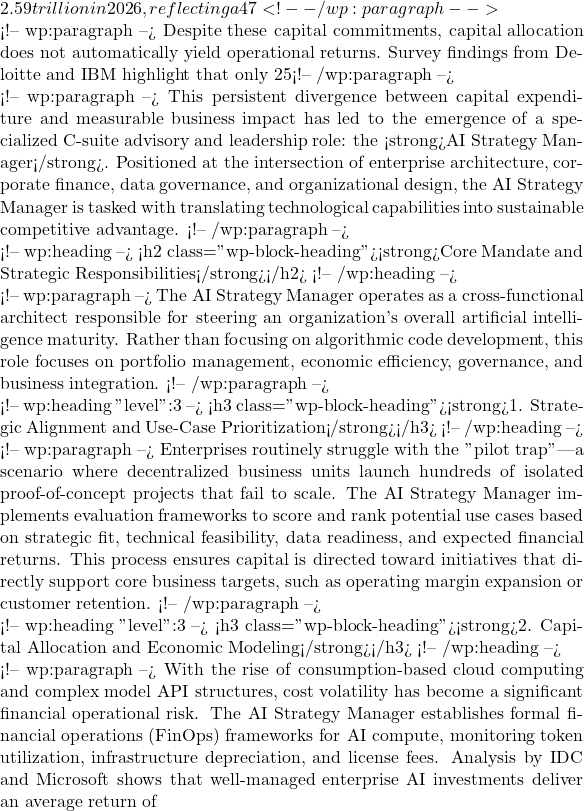



Unilever PLC: Consumer Packaged Goods Supply Chain Automation
Consumer goods giant Unilever uses a unified AI strategy management framework to streamline global supply chain forecasting, ingredient sourcing, and personalized marketing across hundreds of brand portfolios. By transitioning from siloed regional analytics to a federated cloud architecture, Unilever’s strategy managers enabled demand-forecasting models that process real-time market data, significantly reducing inventory holding costs and improving retail fulfillment rates across international markets.
Enterprise AI Economics and Value Realization Framework
A central duty of the AI Strategy Manager is creating clear accountability for capital investments. To quantify value creation, organizations use a structured financial and operational scorecard:
| Strategic Dimension | Key Operational Metrics | Primary Financial Impact |
| Infrastructure & Compute Efficiency | GPU/TPU utilization rate, latency benchmarks, cost per API query | Reduction in cloud compute overspend; lower total cost of ownership |
| Operational Process Automation | First-contact resolution rate, process cycle time, error reduction percentage | Direct operating cost savings; labor efficiency gains |
| Revenue Innovation & Growth | Net new revenue from AI-enabled products, cross-sell conversion lift | Top-line revenue expansion; market share gains |
| Risk & Regulatory Governance | Model audit pass rates, data lineage compliance, policy breach incidents | Prevention of regulatory penalties and litigation risks |
Organizations that achieve top-quartile financial performance systematically manage their AI portfolio as a balanced matrix: roughly 60% of resources are allocated to core efficiency initiatives (low risk, fast payback), 30% to adjacent operational transformations (moderate risk, 12-to-24 month payback), and 10% to disruptive business model innovations (high risk, long-term strategic optionality).
Operating Framework for Strategic Implementation
For organizations seeking to build or mature an AI Strategy function, implementation typically follows a four-phase lifecycle:
- Assessment and Baseline Audit: Conduct a comprehensive inventory of existing data assets, model deployments, cloud contracts, and shadow-IT installations across all business units. Establish baseline metrics for total cost of ownership and risk exposure.
- Governance and Operating Model Design: Define enterprise decision rights, establish an AI Governance Board comprising legal, risk, technology, and business executives, and draft corporate guidelines for acceptable use, data privacy, and vendor selection.
- Portfolio Prioritization and Roadmap Development: Filter corporate demands through a strategic value-versus-complexity matrix. Fund high-impact anchor initiatives while decommissioning redundant or low-performing pilot projects.
- Execution, Measurement, and Scaling: Deploy standardized platform capabilities (such as centralized model registries and evaluation harnesses) to allow business units to deploy applications securely and efficiently. Regularly track ROI against defined hurdle rates and adjust capital allocation accordingly.
Conclusion
The evolution of artificial intelligence from a novel technology into a foundational engine of enterprise commerce demands a shift in executive leadership. High enterprise spending alone does not guarantee organizational success or margin expansion.
The AI Strategy Manager addresses this gap by aligning technological capabilities with core business strategy, establishing rigid financial controls, enforcing regulatory compliance, and driving structural change management. As global investment in artificial intelligence approaches multi-trillion-dollar levels, organizations that establish a disciplined, centralized AI strategy function will be best positioned to mitigate operational risk, maximize capital returns, and secure sustainable market leadership.

