The software industry is undergoing a structural realignment. For decades, the dominant playbook for Software-as-a-Service (SaaS) mandated significant equity capital injection, rapid headcount expansion, and an aggressive pursuit of total addressable market dominance. However, shifting macroeconomic realities, escalating customer acquisition costs, and the democratization of development tools have catalyzed an alternative model: Micro-SaaS.
A Micro-SaaS business operates as a hyper-focused, subscription-based software enterprise designed to solve a specific operational pain point for a defined niche market or platform ecosystem. Typically operated by solo founders or lean teams of fewer than five employees, these organizations prioritize immediate profitability, operational efficiency, and sustainable recurring revenue over capital-intensive top-line growth.
This strategic paper examines the core economic drivers of Micro-SaaS, contrasts its structural characteristics with traditional software models, analyzes real-world global case studies with verified financial performance, and provides an execution framework for entering specialized software markets.
Structural Paradigm: Traditional SaaS vs. Micro-SaaS
To evaluate the commercial viability of Micro-SaaS, business leaders must analyze the divergence in unit economics, capital deployment, and organizational agility between traditional enterprise software and micro-scale solutions.
Traditional SaaS organizations often require multi-million-dollar funding rounds to cover high initial software development cycles, extensive enterprise sales pipelines, and large customer success teams. Consequently, their net burn rates remain elevated for years prior to reaching profitability.
In contrast, Micro-SaaS enterprises leverage off-the-shelf cloud infrastructure, pre-existing developer APIs, and digital distribution channels. This lean structure drastically reduces initial capital expenditure, allowing firms to achieve cash-flow positivity with modest subscriber bases.
| Strategic Attribute | Traditional Enterprise SaaS | Micro-SaaS Model |
| Market Scope | Broad, horizontal, or large enterprise verticals | Specialized, hyper-niche, or platform-dependent |
| Capital Architecture | Venture capital or growth equity | Bootstrapped or self-funded revenue reinvestment |
| Headcount Scale | 50 to 1,000+ full-time employees | 1 to 5 operators or core founders |
| Target Revenue Range |  12K to 12K to 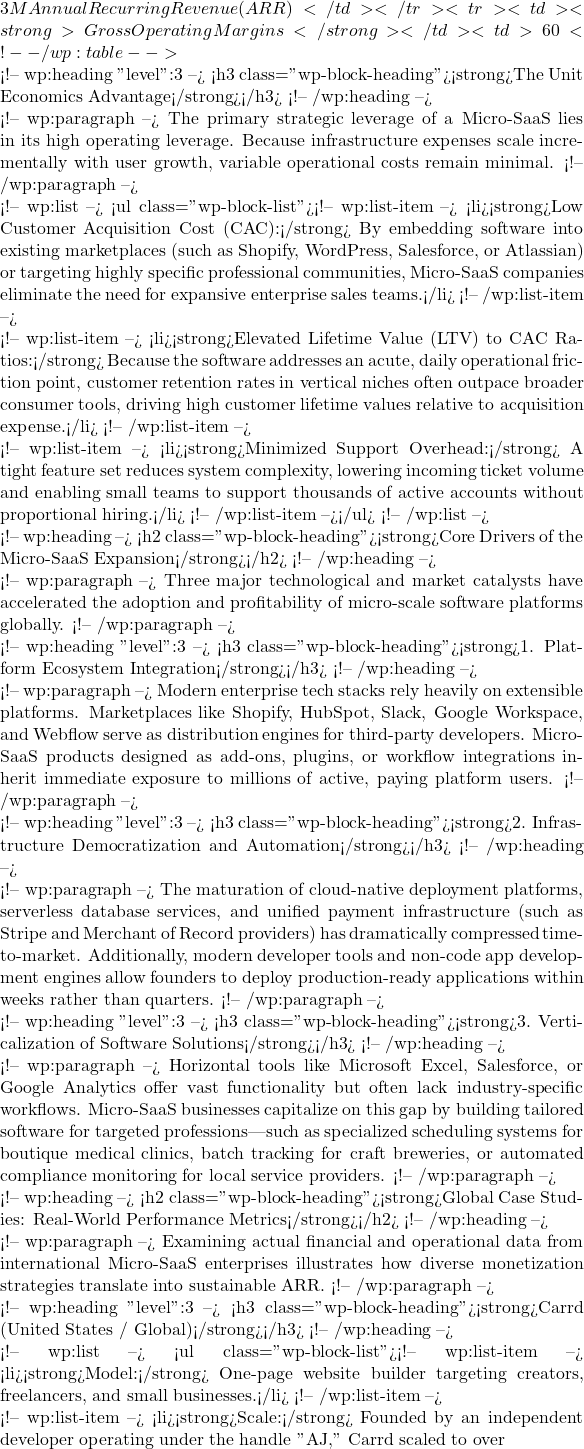 100,000 in Monthly Recurring Revenue (MRR)—representing over 100,000 in Monthly Recurring Revenue (MRR)—representing over  19 per year, Carrd minimized buyer friction. Distribution was driven organically via a “Made with Carrd” footer link on free sites, creating a viral customer acquisition loop with negligible marketing expense. 19 per year, Carrd minimized buyer friction. Distribution was driven organically via a “Made with Carrd” footer link on free sites, creating a viral customer acquisition loop with negligible marketing expense.Plausible Analytics (Estonia / European Union)
FeedbackPanda (Germany / Global)
Strategic Framework for Market Entry and ScalingBuilding a successful Micro-SaaS requires an execution strategy focused on immediate validation, disciplined product scope, and efficient distribution. Phase 1: Niche Friction IdentificationRather than attempting to invent new software categories, founders should identify existing manual workarounds within established software platforms or industry workflows. Prime indicators of opportunity include:
Phase 2: Scoping the Minimum Viable Product (MVP)A core failure mode for software startups is feature creep. A Micro-SaaS MVP must solve one specific problem with high reliability. Features that do not directly contribute to solving the central pain point should be excluded from initial builds to keep maintenance requirements low. Phase 3: Monetization and Value-Based PricingLow-priced software plans (under Phase 4: Sustainable Distribution ChannelsTo maintain low Customer Acquisition Costs, founders must build distribution into their market positioning:
Strategic Risks and MitigationWhile the Micro-SaaS model delivers high profit margins and operational freedom, operators face distinct structural risks:
ConclusionThe Micro-SaaS model represents a maturation of the modern software economy. By shifting focus from venture-funded market dominance toward lean operational efficiency and acute problem-solving, micro-enterprises achieve sustainable profitability and high gross margins. For solo developers, software architects, and domain experts, Micro-SaaS offers a scalable mechanism to convert specialized industry insight into recurring software revenue. As cloud infrastructure simplifies and niche digital economies expand worldwide, the prevalence of focused, highly profitable micro-software companies will remain a primary driver of entrepreneurial innovation in the software industry.  I am the Founder and Editor-in-Chief of the SuperBusinessManager.com website. I am the EU citizen with approximately 20 years of experience in secondary and higher business education in both public and private sectors. Currently living with my wife and our two adorable children in China where I teach Business Management and Economics at K-12 international schools. Professionally, I am an experienced Lecturer and Researcher in Business Management and Economics, as well as IB Examiner for DP Business Management at International Baccalaureate (IB). Privately, I enjoy reading and collecting books on business management, personal finance and investing. You can contact me at jerrygrzegorzek@hotmail.com |
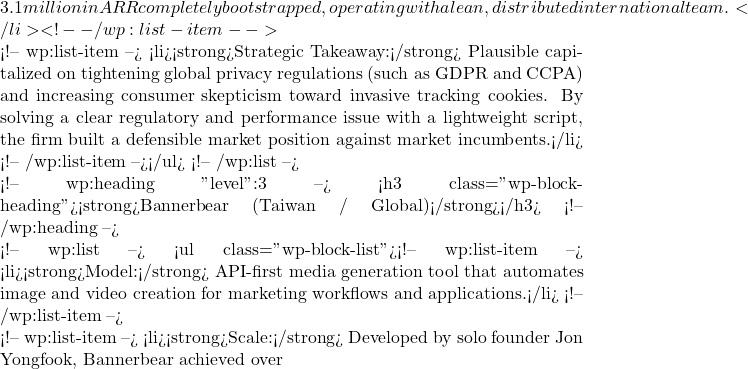 20,000 in MRR with high profit margins, operating as an “Open Startup” that shares operational transparently.
 660,000 ARR) within two years before being acquired by a private equity firm.
 29 and $199 per month, positioning the fee against the labor cost savings provided by the software.