How Global Institutions Build Multibillion-Dollar Wealth Engines?
The world’s premier universities are often viewed as centers of higher learning, but behind the ivory towers sits some of the most sophisticated financial machinery on the planet.
Elite institutions manage capital on par with major sovereign wealth funds, shielding themselves from economic downturns while securing multi-generational financial power.
Understanding how university endowments operate reveals the hidden mechanics of institutional wealth management and provides critical lessons for private investors looking to scale their portfolios.
The Scale of Institutional Higher Education Wealth
To understand the power of these financial engines, one must look at the sheer scale of the largest capital pools.
These institutions do not merely save money; they operate complex investment corporations designed to outpace inflation and fund a massive share of university operations.
The largest higher education endowments command staggering market values:
| University | Endowment Market Value |
| Harvard University |  44.15 Billion 44.15 Billion |
| Stanford University |  36.42 Billion 36.42 Billion |
| Massachusetts Institute of Technology (MIT) | 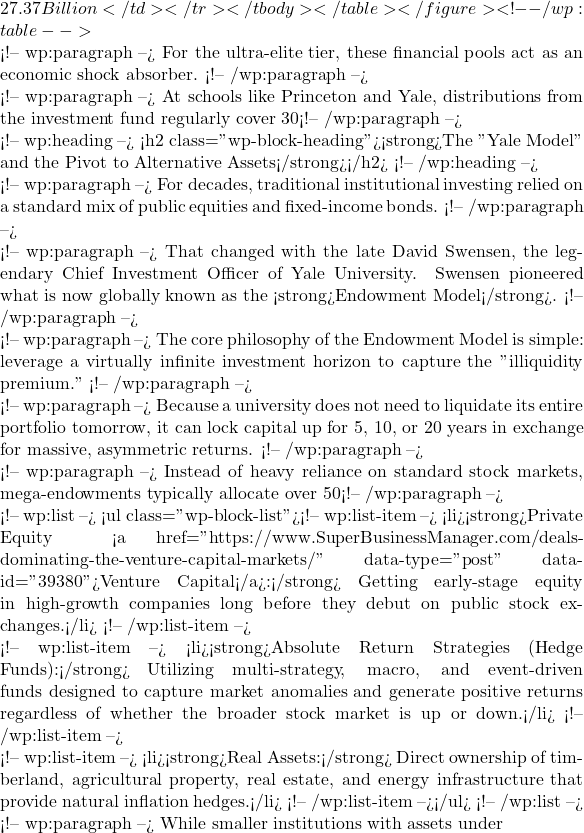 250 million still hold roughly half of their wealth in highly liquid public equities, mega-funds (those over $5 billion) restrict public equity exposure to less than a quarter of their portfolio, routing the rest into complex, private vehicles. 250 million still hold roughly half of their wealth in highly liquid public equities, mega-funds (those over $5 billion) restrict public equity exposure to less than a quarter of their portfolio, routing the rest into complex, private vehicles.Operating with Layered Liquidity and High DependencyOperating a multibillion-dollar fund with a massive chunk of money tied up in illiquid assets requires an incredibly disciplined approach to cash flow management. This framework is known as layered liquidity. Endowment managers meticulously divide portfolios into tiers based on when cash can be accessed: Tier 1: Immediate Cash & Core Bonds -> Covers immediate operating expenses This structural discipline has become increasingly critical as universities face shifting macroeconomic pressures, including rising operating costs and changes in student demographics. Data from the NACUBO-Commonfund Study shows that the average net return for higher education endowments hit 10.9%, yet schools are leaning on these funds more than ever. Operating reliance on endowment distributions has risen steadily, highlighting a growing wealth gap in higher education. Elite, asset-heavy institutions leverage a strong endowment-to-debt ratio to self-fund strategic growth, while smaller schools without massive private capital access find themselves highly vulnerable to market volatility. The Strategic Takeaway for Private WealthThe ultimate secret of university endowments is not that they have access to exotic, hidden investments, but that they maximize the structural advantages of their specific financial position. They treat time as an asset class. By matching long-term financial liabilities with illiquid, high-yield assets—while maintaining a strictly managed buffer of liquid capital for short-term needs—institutional investors effectively remove emotion from asset management. Whether navigating policy changes or unexpected market dips, the playbook remains focused on manager selection, global diversification, and disciplined asset pacing.  I am the Founder and Editor-in-Chief of the SuperBusinessManager.com website. I am the EU citizen with approximately 20 years of experience in secondary and higher business education in both public and private sectors. Currently living with my wife and our two adorable children in China where I teach Business Management and Economics at K-12 international schools. Professionally, I am an experienced Lecturer and Researcher in Business Management and Economics, as well as IB Examiner for DP Business Management at International Baccalaureate (IB). Privately, I enjoy reading and collecting books on business management, personal finance and investing. You can contact me at jerrygrzegorzek@hotmail.com |