The Power of Long-Term Wealth Accumulation: Analyzing Jeremy Siegel’s Multi-Century Asset Return Benchmark.
Understanding the long-term performance of capital markets is fundamental to corporate finance, institutional asset management, and personal investment strategy. One of the most famous datasets in financial economics was constructed by Wharton Professor Jeremy J. Siegel in his landmark study, Stocks for the Long Run. By tracking the inflation-adjusted total returns of major financial assets from 1802 through the modern era, Siegel demonstrated how different asset classes preserve and expand purchasing power over centuries.
The central thesis of Siegel’s research is stark: over multi-decade horizons, equities consistently outpace all other asset classes in generating real wealth. Conversely, holding cash or non-productive commodities yields flat or negative real returns due to the persistent drag of monetary inflation. Examining this historical dataset provides strategic insights into asset allocation, capital budgeting, and risk management.
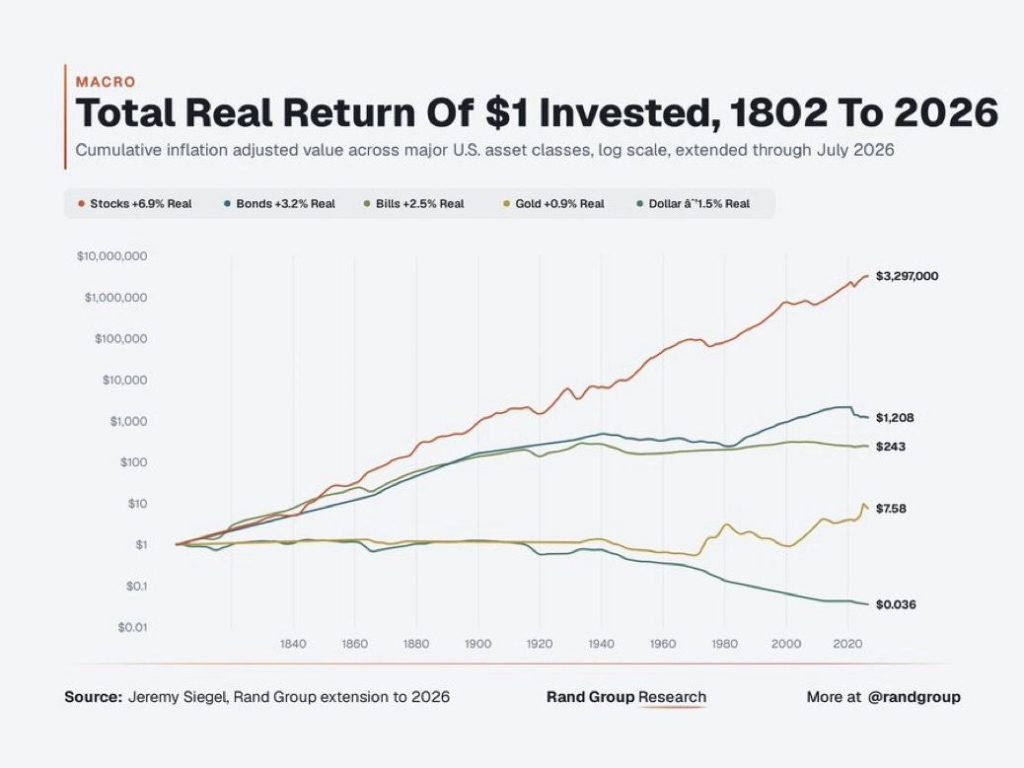
The Historical Empirical Data: 1.00 into various asset classes in 1802, the cumulative real purchasing power generated across more than two centuries demonstrates the compound effect of capital growth:
U.S. Equities: Equities delivered an average annualized real return of approximately 6.8% to 6.9%. A single dollar invested in 1802 grew to over 1 grew to approximately 2,000 in real terms. While bonds provide stability, their long-term growth capacity is significantly muted compared to stocks.
Treasury Bills (Short-Term Debt): Serving as cash equivalents, short-term Treasury bills generated an average real annual return of about 2.5%. The initial 230 in purchasing power.
Gold: Precious metals functioned primary as a store of value rather than a growth engine. With an average real annual return of approximately 0.6%, 4.00 in real purchasing power. Gold preserved purchasing power against inflation but generated minimal real capital expansion.
Uninvested U.S. Dollar: Currency exposed to persistent inflation experienced a net erosion of value, declining at an average real rate of -1.4% annually. The purchasing power of a paper dollar held in cash since 1802 collapsed to roughly 3 to 4 cents.
1 Invested, 1802 to 2026.
Core Economic Drivers of Equity Superiority
The dramatic performance disparity between equities and other asset classes stems from underlying economic mechanisms.
Equities represent residual claims on productive corporations. Unlike debt instruments, which pay fixed nominal interest, corporations can pass cost increases along to consumers, adjust capital allocation dynamically, and capture gains from technological innovation.
Global multinational corporations illustrate this capacity:
Apple Inc. (United States): By continually reallocating capital into consumer technology ecosystems, services, and proprietary hardware, Apple has generated returns far exceeding general economic growth rates.
Toyota Motor Corporation (Japan): Through lean manufacturing innovations and international expansion, Toyota converted industrial operations into sustained long-term enterprise value.
Nestlé S.A. (Switzerland): By maintaining consumer pricing power across global consumer staples markets, Nestlé effectively insulates investor capital from inflationary pressures.
2. The Power of Dividend Reinvestment
A substantial portion of total stock returns over multi-decade periods originates from reinvested cash flows rather than share price appreciation alone. Reinvested dividends purchase additional shares during market downturns, creating an accelerating compounding loop when markets recover.
3. Structural Inflation Hedging
In the long run, business revenues and earnings tend to track aggregate price levels because companies adjust prices in response to wage and input cost inflation. Debt instruments, by contrast, pay fixed coupons that suffer purchasing power loss during periods of elevated inflation.
Strategic Portfolio Implications
The multi-century empirical evidence established by Jeremy Siegel offers clear guidance for institutional and individual capital allocation strategies:
Cash poses a long-term risk: While short-term liquidity is essential for operational risk management, holding excess cash guarantees purchasing power degradation over extended horizons due to monetary inflation.
Gold is a hedge, not a wealth generator: Gold serves as a stabilization asset during severe geopolitical or financial crises, but its lack of cash flow generation limits its ability to accumulate wealth over multi-decades.
Fixed income requires careful duration management: Long-term bonds provide income stability and downside protection during sudden economic shocks, but their lower real yields make them secondary vehicles for wealth accumulation.
Equity allocation is critical for multi-generational growth: Sovereign wealth funds, university endowments, and pension funds structure their strategic asset allocations around core equity exposures to ensure asset growth exceeds long-term liabilities and inflation targets.
Conclusion
Jeremy Siegel’s historical dataset confirms that over extended periods, equities outperform all alternative asset classes.
A single dollar invested in 1802 expanded into millions of dollars in real terms through equity ownership, whereas holding physical currency resulted in nearly complete loss of real purchasing power.
For modern investors and corporate leaders, these results highlight the vital importance of allocating patient capital into productive, cash-generating enterprises to preserve and build long-term real wealth.
Jerry Grzegorzek
I am the Founder and Editor-in-Chief of the SuperBusinessManager.com website. I am the EU citizen with approximately 20 years of experience in secondary and higher business education in both public and private sectors. Currently living with my wife and our two adorable children in China where I teach Business Management and Economics at K-12 international schools. Professionally, I am an experienced Lecturer and Researcher in Business Management and Economics, as well as IB Examiner for DP Business Management at International Baccalaureate (IB). Privately, I enjoy reading and collecting books on business management, personal finance and investing. You can contact me at jerrygrzegorzek@hotmail.com
 1.00 into various asset classes in 1802, the cumulative real purchasing power generated across more than two centuries demonstrates the compound effect of capital growth:
 1 grew to approximately
  2,000 in real terms. While bonds provide stability, their long-term growth capacity is significantly muted compared to stocks.
 230 in purchasing power.
 4.00 in real purchasing power. Gold preserved purchasing power against inflation but generated minimal real capital expansion.
 1 Invested, 1802 to 2026.