In the global commercial landscape, supply chain management has fundamentally evolved from a reactive tactical utility into a primary engine of competitive advantage, capital allocation efficiency, and balance sheet performance. Total U.S. business logistics expenditure has climbed to 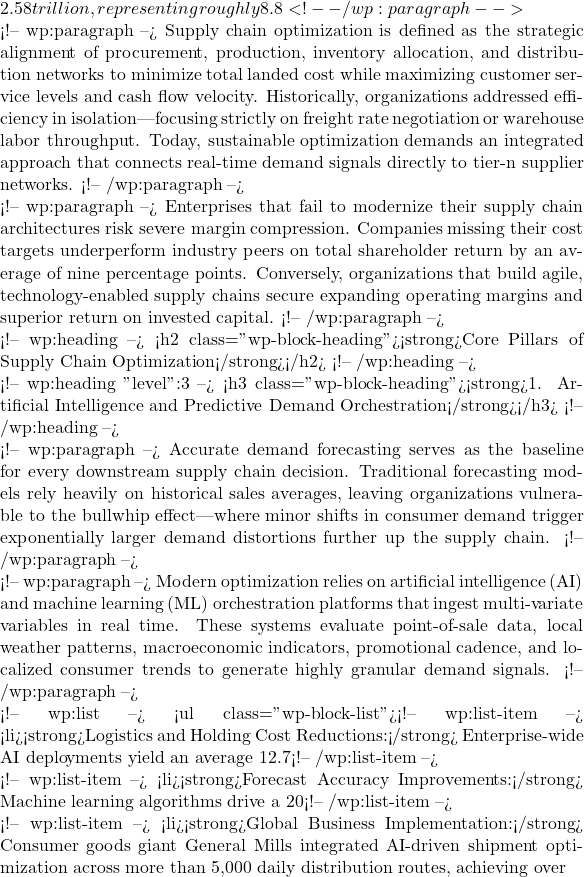 20 million in cumulative operational savings.
Optimizing the demand signal enables procurement teams to align raw material orders with actual consumption rates, eliminating unnecessary working capital lockup.
2. Multi-Echelon Inventory Optimization and Capital Efficiency
Managing inventory across multiple nodes—such as central distribution centers, regional fulfillment hubs, and retail stores—requires sophisticated Multi-Echelon Inventory Optimization (MEIO). Rather than holding static safety stock at every node, MEIO dynamically shifts inventory balances based on regional lead times, demand variance, and stockout costs.
Inventory management is closely tied to corporate cash conversion cycles, specifically working capital metrics like Days Payable Outstanding (DPO) and Days Sales of Inventory (DSI). Two distinct global strategies illustrate the impact of supply chain structure on financial performance:
- Amazon’s Regionalized Automation Node Model: Amazon decentralized its legacy national logistics framework into eight distinct regional fulfillment nodes. Supported by over 520,000 warehouse automation robotics systems, Amazon lowered fulfillment costs by 20% while accelerating order throughput by 40%. Furthermore, Amazon leverages an enterprise Days Payable Outstanding (DPO) of 110.8 days, effectively converting supplier payment terms into a zero-cost financing float to fund major infrastructure expansion.
- Walmart’s Omni-Channel Hub Strategy: Utilizing its network of more than 4,700 retail locations as micro-fulfillment centers, Walmart leverages physical proximity to shorten the final mile. Powered by predictive inventory algorithms analyzing 200 variables per stock-keeping unit (SKU), Walmart reduced holding costs by $1.5 billion annually while sustaining an on-shelf stock rate of 99.2%.
3. Upstream Multi-Tier Visibility and Resilient Sourcing Networks
Systemic disruptions—ranging from regional climate events to maritime corridor blockages—occur with an average frequency of every 3.7 years. Despite these operational hazards, benchmark data reveals that while 93% of executives express high confidence in primary operations, only 56% can map their supply networks down to Tier-3 and Tier-4 material suppliers.
True supply chain resilience requires moving away from single-source, low-cost country sourcing toward nearshoring, dual-sourcing, and automated risk mitigation platforms. Key global examples highlight the power of digital visibility:
- Schneider Electric: Recognized as a top global supply chain leader by Gartner, Schneider Electric implemented an adaptive machine learning platform across 160 factories and 75 distribution hubs worldwide. By automating real-time parameters for safety stock, lead times, and order quantities, the platform unlocked over €100 million in structural cost savings.
- Unilever and Procter & Gamble: Both global consumer products leaders maintain top-tier supply chain execution by establishing localized regional manufacturing ecosystems. This strategy reduces international transport exposure, insulates the balance sheet from dynamic tariff adjustments, and cuts overall transit lead times.
4. Smart Manufacturing and Operational Automation
Within physical processing facilities, smart manufacturing technologies are driving major structural cost improvements. Over 78% of global industrial manufacturers now dedicate more than 20% of their total operational improvement capital to smart facility initiatives.
The convergence of Internet of Things (IoT) sensors, process automation, and computer vision delivers clear productivity gains:
- Facility Productivity Gains: Smart factory implementations generate average facility-level productivity improvements of 7% to 20%.
- Fulfillment Accuracy: High-precision computer vision systems deployed in order-picking facilities achieve fulfillment accuracy rates of 99.8%, preventing expensive return processing cycles.
- Predictive Maintenance: IoT vibration and thermal sensors on critical material handling equipment allow maintenance teams to fix machinery prior to failure, avoiding costly unscheduled assembly line downtime.
Comparative Metrics in Supply Chain Transformation
The strategic trade-offs between traditional supply chain execution and optimized enterprise architectures are summarized below:
| Performance Metric | Traditional Supply Chain Architecture | Optimized & AI-Enabled Architecture |
| Demand Forecast Accuracy | 60% – 70% static historical averages | 85% – 95% dynamic machine learning models |
| Inventory Holding Costs | High baseline with localized safety stock buffers | 15% – 20% reduction via dynamic multi-echelon placement |
| Upstream Network Visibility | Limited to Tier-1 direct vendor relationships | Multi-tier traceability (Tier-3 and Tier-4 coverage) |
| Disruption Recovery Speed | Days to weeks; manual rerouting | Real-time automated mitigation and dynamic re-sourcing |
| Order Picking Accuracy | 92% – 95% manual verification | 99.8% computer vision and robotic orchestration |
Conclusion
Supply chain optimization is no longer a localized exercise in cost cutting; it is an integrated enterprise strategy that directly drives top-line revenue growth, operating margin expansion, and working capital efficiency. Navigating ongoing global economic complexity requires C-suite leaders to treat supply chain design as an ongoing, technology-driven discipline.
The path forward centers on three core strategic mandates:
- Institutionalize Predictive AI: Replace reactive planning with machine learning demand sensing to eliminate inventory distortion and optimize capital allocation across every node.
- Prioritize Network Resilience Over Unit Cost: Construct multi-tier supply networks with nearshore capabilities to absorb tariff changes and regional logistics shocks.
- Automate Operational Workflows: Deploy smart warehousing, robotics, and end-to-end visibility platforms to lock in structural productivity gains and maintain superior fulfillment speeds.
Organizations that commit to this comprehensive framework protect their balance sheets against macro shocks, outpace competitors in capital efficiency, and deliver sustainable value to shareholders.
