Equity markets serve as the operational bedrock of contemporary global capitalism. By bridging the gap between economic units with surplus capital and corporate entities requiring long-term financing, equity exchanges facilitate capital allocation, risk distribution, and wealth creation across macroeconomic systems.
Rather than functioning merely as trading venues, stock markets form an integrated financial framework that translates liquid savings into productive corporate capacity.
The primary functions of equity markets encompass mobilizing individual and institutional savings, offering secondary liquidity for ownership transfers, providing primary capital formation for corporate expansion, establishing precise enterprise valuations, and transforming liquid cash into fixed productive assets.
I. Facilitating Capital Accumulation and Mobilizing Savings
At a macroeconomic level, sustained economic expansion requires continuous reinvestment. Equity markets provide a standardized, regulated environment for retail investors, pension funds, and institutional asset managers to channel pooled savings away from idle cash or low-yielding cash equivalents into income-generating equity assets.
Without structured public equity markets, individual savings remain vulnerable to real purchasing power erosion caused by inflation. By converting liquid cash into equity shares, investors secure fractional ownership in commercial enterprises, gaining exposure to corporate revenue growth, dividend distributions, and long-term asset appreciation.
Global Business Example
This mobilization function is demonstrated on a massive scale by sovereign wealth funds and institutional pension systems. Norway’s Government Pension Fund Global (GPFG), managed by Norges Bank Investment Management, holds over 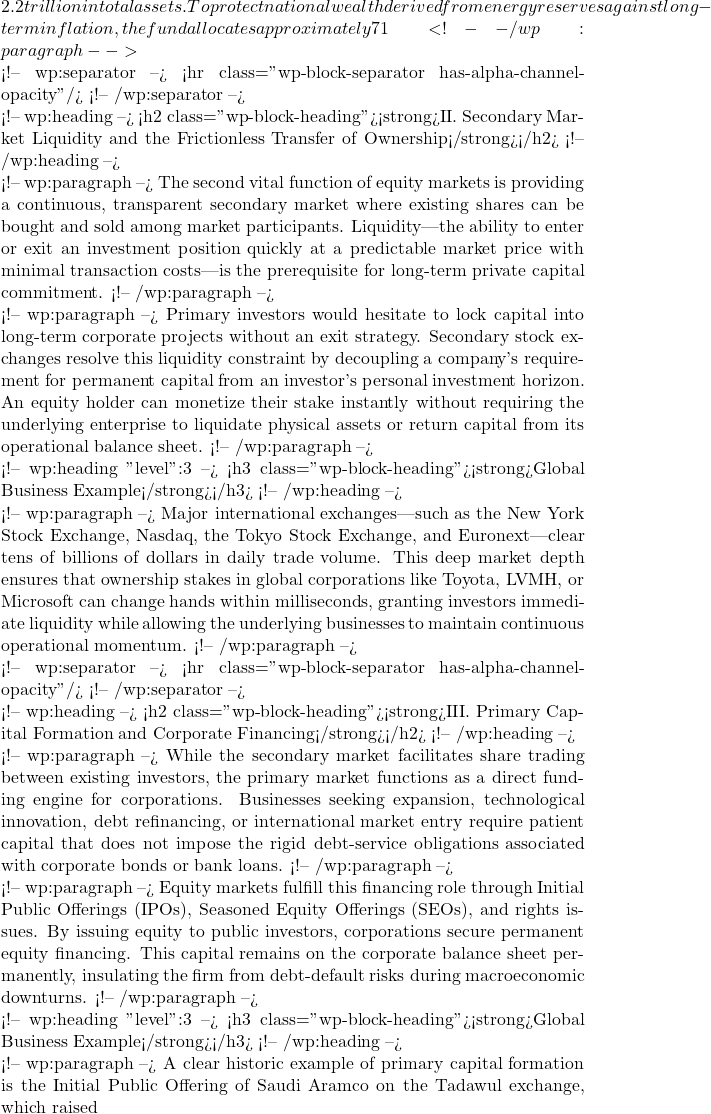

IV. Enterprise Valuation and Dynamic Price Discovery
Equity markets function as real-time information-processing systems, synthesizing macroeconomic trends, corporate earnings reports, competitive advantages, and risk variables into a single transparent output: the market share price.
This continuous price discovery establishes the market capitalization of listed corporations, delivering an objective framework for valuation. Accurate market valuation serves several critical roles:
- It guides corporate board decisions regarding strategic mergers and acquisitions (M&A).
- It establishes transparent benchmarks for corporate governance and performance-based executive compensation.
- It sends clear economic signals that direct capital toward high-return, innovative sectors while starving obsolete or inefficient business models of low-cost capital.
Global Business Example
The dynamic valuation power of public equity markets is illustrated by the pricing of artificial intelligence infrastructure providers. Driven by surging global demand for advanced computing hardware, Nvidia’s market capitalization expanded beyond 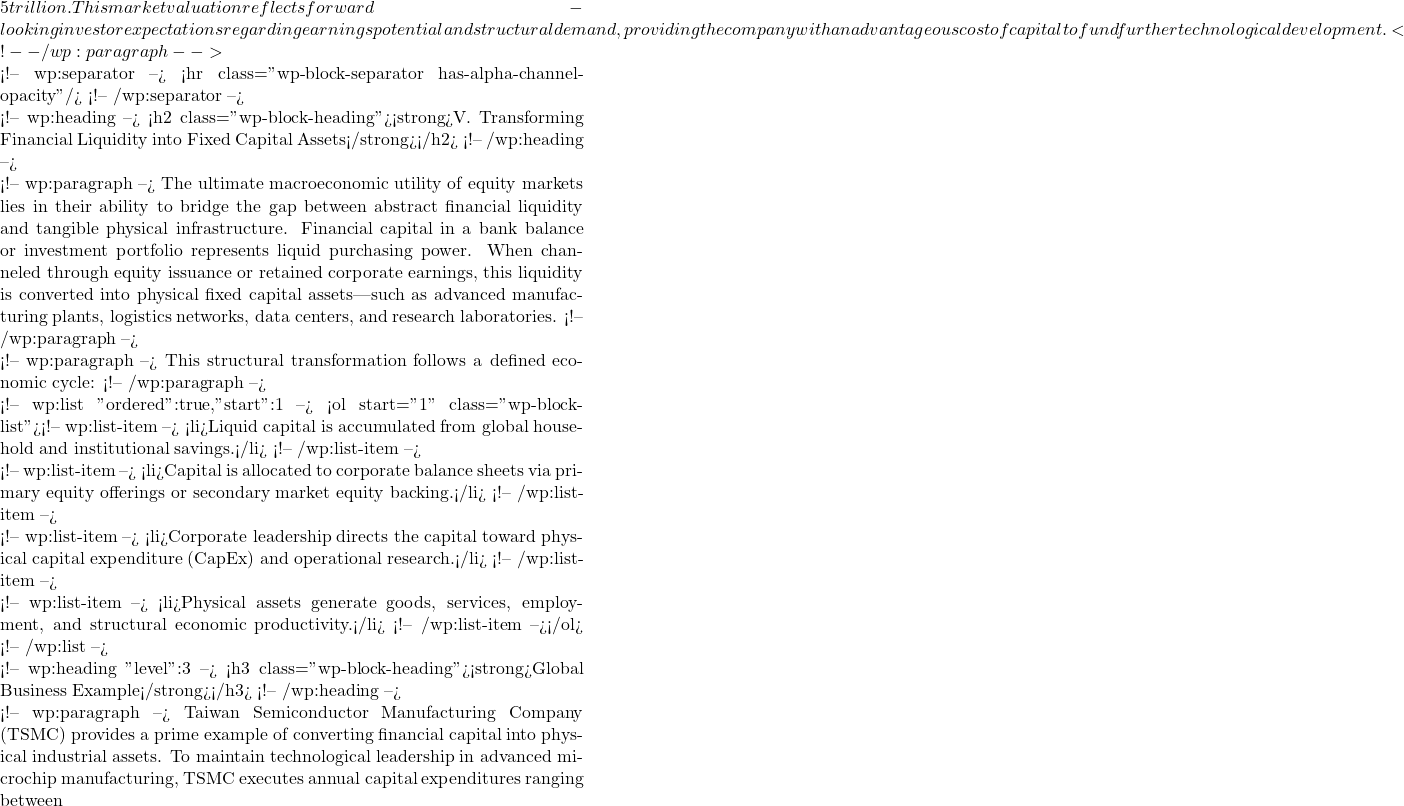

Conclusion
The stock market is an essential structural framework that aligns the objectives of individual savers, corporate leaders, and national economies.
By mobilizing savings, providing secondary market liquidity, facilitating primary capital formation, enabling enterprise price discovery, and converting liquid cash into fixed capital assets, public equity markets drive allocative efficiency and industrial progress.
In an increasingly complex economic environment, maintaining transparent, liquid, and well-regulated stock markets remains essential for long-term global prosperity.
—
Main functions of the stock market:

1. An outlet for our savings to be invested.
2. A place to buy and sell pieces of companies.
3. A source of finance for companies seeking more capital.
4. An instrument for valuing giant corporations.
5. A place to transform cash into fixed capital assets.

