For generations, stock market investing has been wrapped in complex narratives of market psychology, shifting multiples, and the daily theater of price charts. It is easy to look at a flashing green ticker and believe that wealth creation is simply a game of selling a piece of paper to someone else at a higher price.
But when you strip away the speculation, algorithmic trading, and media noise, what are you actually buying when you purchase a share of stock?
In 1938, an economist and investment analyst named John Burr Williams provided the definitive, uncompromising answer in his seminal work, The Theory of Investment Value. Williams formalized the Dividend Discount Model (DDM), establishing a foundational economic law that remains the ultimate reality check for any investor: a stock is worth nothing more, and nothing less, than the present value of the cash it pours back into the hands of its owners.
The Purest Definition of Value
Before Williams published his thesis, equity valuation was a crude mix of guesswork and asset accounting. Many investors valued companies based purely on book value (the physical assets on the balance sheet) or current earnings.
Williams saw the flaw in this logic. A company can own massive factories, cutting-edge equipment, and billions in reported accounting profits, but if that wealth remains trapped inside the corporate structure forever, it does nothing for the individual shareholder.
Williams’ breakthrough was shifting the focus from corporate accounting to investor reality. He argued that from the perspective of an outside shareholder, dividends are the only tangible return an investor can ever truly expect.
To understand why, consider the two ways an investor makes money from a stock:
- Capital Appreciation: Selling the stock to another investor for a higher price.
- Dividends: Receiving direct cash distributions from the company.
While capital appreciation feels real on a brokerage statement, it relies entirely on the willingness of a future buyer to pay more than you did. Why will that future buyer pay more? Because they expect their future buyer to pay even more. Williams exposed this infinite loop. For a stock to have any fundamental, intrinsic value at all, that chain of buyers must eventually lead to an owner who is rewarded by the cash flowing out of the business itself.
Without the promise of cash distributions, a stock is merely a digital baseball card—valuable only as long as a greater fool is willing to trade for it.
The Mathematics of Patience
Williams translated this philosophy into a mathematical framework. The general Dividend Discount Model states that the intrinsic value of a share of stock is calculated by taking every single dividend the company will pay from today until the end of time, and discounting those future payments back to today’s dollars using a required rate of return.
Because a dollar received ten years from now is worth less than a dollar in your hand today—due to inflation and the opportunity cost of time—those distant dividends are heavily discounted.
The beauty of Williams’ framework is its absolute flexibility. Unlike later, simplified variations like the Gordon Growth Model—which rigidly assumes a company will grow its payouts at an exact, constant rate forever—Williams’ original concept handles the erratic, unpredictable nature of real-world business. It acknowledges that a company might pay a small dividend today, double it in five years, cut it during a global recession, and aggressively ramp it up a decade later.
Real-World Proof: When Cash Distributes Reality
The truth of Williams’ model becomes glaringly obvious when we examine the corporate lifecycles of global businesses.
Consider Apple. For years during its hyper-growth phase in the late 1990s and 2000s, Apple paid no dividend. It reinvested every dollar of cash flow into inventing the iPhone and expanding its ecosystem. Under Williams’ logic, the stock was still valuable because investors anticipated that this massive cash hoarding would eventually result in an unparalleled cash payout down the road. In 2012, that expectation became reality when Apple initiated one of the largest dividend and share buyback programs in corporate history, returning hundreds of billions of dollars directly to shareholders.
Conversely, look at the cautionary tale of Intel. For years, the chipmaker maintained a steady dividend, keeping income-focused investors satisfied. However, as the company lost its manufacturing edge to global rivals like Taiwan Semiconductor Manufacturing Company (TSMC) and missed the initial artificial intelligence wave, its underlying cash flows came under immense pressure. In 2024, facing the reality of massive capital expenditure needs to rebuild its business, Intel suspended its dividend entirely. Instantly, the stock plummeted to multi-decade lows. The market adjusted to Williams’ reality: when the tangible cash return vanishes into the indefinite future, the intrinsic value of the equity crumbles.
Modern Nuance: Buybacks vs. Dividends
In today’s global financial markets, companies frequently return cash to shareholders through share buybacks rather than direct dividends. Does this invalidate Williams’ model?
Not at all. When a company like the American conglomerate Berkshire Hathaway or the French luxury giant LVMH repurchases its own shares, it reduces the total number of shares outstanding. While it isn’t sending a direct dividend check to your mailbox today, it is giving you a larger percentage ownership of the company’s future cash flows.
A share buyback is simply a deferred dividend. By reducing the share count, the company ensures that when a dividend is eventually paid—or when the company is ultimately liquidated or acquired—each remaining share receives a significantly larger piece of the cash pie. The underlying principle remains completely unchanged: the value is entirely derived from the cash expected to come out of the enterprise.
The Investor’s Ultimate Anchor
The practical power of Williams’ Dividend Discount Model is that it acts as a psychological anchor during market madness.
When a sector experiences a speculative bubble and stocks trade at absurd multiples of revenue with no path to profitability, Williams’ model quietly asks: “What is the realistic timeline for this business to hand cash back to its owners, and how much will they get?” If the answer is “decades from now, and very little,” the asset is a gamble, not an investment.
Ultimately, John Burr Williams reminded the financial world of a simple truth that any small business owner intuitively understands. A business is a machine designed to generate cash for its proprietors. No matter how complex global equity markets become, the ultimate value of a stock will always come down to the tangible cash returns it delivers to the people who took the risk to own it.
How to determine value of a common stock? Estimate cash flows into infinity and discount them to find out the present value of future cash flows.
The intrinsic value of a stock is determined by the total present value of all future cash flows distributed by a company to its shareholders over the long term. This flow of cash back to the investor represents the only tangible return on the money invested and encompasses regular dividend distributions, liquidation payments, and proceeds realized from corporate takeovers.
Investors shall generate a return of the money invested in the form of cash back to the owner of the stock.
To calculate the intrinsic value of a stock using John Burr Williams’ original Dividend Discount Model, you must find the Present Value (PV) of every dividend the company will pay in the future.
Because money has a time value (a dollar today is worth more than a dollar tomorrow), you cannot just add up the future dividends. You must “discount” each one back to today’s dollars using your required rate of return (the annual return you demand for taking on the risk of owning the stock).
The standard mathematical formula for Williams’ general model looks like this:
![\[Value = \frac{D_1}{(1 + r)^1} + \frac{D_2}{(1 + r)^2} + \frac{D_3}{(1 + r)^3} + \dots + \frac{D_n}{(1 + r)^n}\]](https://www.SuperBusinessManager.com/wp-content/ql-cache/quicklatex.com-80dc342e8ee83402fd7f11af3434bdf3_l3.png "Rendered by QuickLaTeX.com")

Where:



How to Calculate It (Step-by-Step)?
Because Williams’ original model allows for erratic, changing dividends, analysts typically break the calculation down into steps using a Multi-Stage DDM. This is how you would evaluate a real-world company experiencing a period of high growth before settling into maturity.
Step 1: Forecast the Near-Term Dividends
Estimate the exact dollar amount of the dividends the company will pay over a predictable near-term horizon (usually the next 3 to 5 years).
Step 2: Discount Those Near-Term Dividends to Today
Divide each forecasted dividend by 

Step 3: Calculate the “Terminal Value”
Since you cannot forecast individual dividends forever, you assume that after your near-term horizon (e.g., Year 4 and beyond), the company will finally stabilize and grow its dividend at a constant, realistic rate (

At that cliff edge, you use the simplified Gordon Growth Model shortcut to find the value of all remaining infinite dividends combined. This is called the Terminal Value (

![\[TV = \frac{D_{stable}}{r - g}\]](https://www.SuperBusinessManager.com/wp-content/ql-cache/quicklatex.com-0f43436e6a8819b7c2e97b3eed81f836_l3.png "Rendered by QuickLaTeX.com")

Step 4: Discount the Terminal Value back to Today
Because that massive Terminal Value block sits at the end of your near-term forecast, you must discount that entire lump sum back to today’s dollars.
Step 5: Add It All Together
Add the present value of your individual near-term dividends (Step 2) to the present value of your Terminal Value (Step 4). The result is the absolute maximum price you should pay for the stock today.
A Real-World Example
Let’s say you want to value a fictional global tech firm that is rapidly scaling its payout.
- The stock currently pays no dividend, but is legally committed to paying USD2.00 next year (Year 1).
- Driven by a major product cycle, the dividend will jump to USD3.50 in Year 2 and USD5.00 in Year 3.
- After Year 3, the company will mature, and its dividend will grow at a steady 3% stable rate (
- You demand a 9% required rate of return (


Here is how you calculate the intrinsic value today:
1. Present Value of Near-Term Dividends
- Year 1 Dividend (USD2.00):
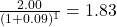
- Year 2 Dividend (USD3.50):
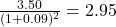
- Year 3 Dividend (USD5.00):
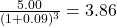
- Sum of near-term cash flows =


2. Calculate and Discount the Terminal Value (Year 4 and Beyond)
First, find the Year 4 dividend by applying the 3% permanent growth rate to the Year 3 dividend:
![\[5.00 \times 1.03 = \$5.15\]](https://www.SuperBusinessManager.com/wp-content/ql-cache/quicklatex.com-d68d77f27199d247916a88aca3594b5b_l3.png "Rendered by QuickLaTeX.com")

Next, calculate the Terminal Value at the end of Year 3:
![\[TV = \frac{5.15}{0.09 - 0.03} = \frac{5.15}{0.06} = \$85.83\]](https://www.SuperBusinessManager.com/wp-content/ql-cache/quicklatex.com-2802a2cebadbe4b76127229d1f315e9c_l3.png "Rendered by QuickLaTeX.com")

Now, discount that USD85.83 Terminal Value back 3 years to find its value today:
![\[\text{PV of Terminal Value} = \frac{85.83}{(1 + 0.09)^3} = \$66.28\]](https://www.SuperBusinessManager.com/wp-content/ql-cache/quicklatex.com-fcfd04608bb8133a453743ee5749826e_l3.png "Rendered by QuickLaTeX.com")

3. Total Intrinsic Value
Add your two pieces together:
![\[\text{Intrinsic Value} = \$8.64 \text{ (Near-Term)} + \$66.28 \text{ (Terminal)} = \$74.92\]](https://www.SuperBusinessManager.com/wp-content/ql-cache/quicklatex.com-8bd014ed9f5d6d8092995a552c236d37_l3.png "Rendered by QuickLaTeX.com")

If the stock is currently trading on the market below USD74.92, Williams’ model tells you it is undervalued and represents a solid buy based entirely on the tangible cash returns it will hand you over time.

