You can think of a bond as a loan you make to a company or government. They promise to pay you back your initial investment, the face value, on a specific date, the maturity date. In the meantime, they pay you a fixed amount of interest, the coupon, at regular intervals.
While this may seem straightforward, a bond’s price in the market can change daily. This is due to a key principle in finance: the inverse relationship between interest rates and bond prices. When market interest rates rise, newly issued bonds offer higher coupons, making older bonds with lower fixed coupons less attractive.
To compete, the price of existing bonds must fall, making their yield more appealing. Conversely, when rates fall, existing bonds with higher coupons become more valuable, and their price rises.
This is where bond valuation comes in. It’s the process of determining a bond’s fair market value based on the present value of its future cash flows. Here’s a look at the most common ways to value a bond.
1. Present Value Method
The most fundamental way to value a bond is by calculating the present value of all its future cash flows.
This involves discounting each of the coupon payments and the final face value back to today’s dollars using a market-determined interest rate or yield to maturity (YTM).
The formula for a bond’s price (V) is:
V = ∑t=1 C / ((1 + r)^t) + F / ((1+r)^n)
Where:
C = Coupon payment per period
F = Face value of the bond
r = Market interest rate or YTM
n = Number of periods until maturity
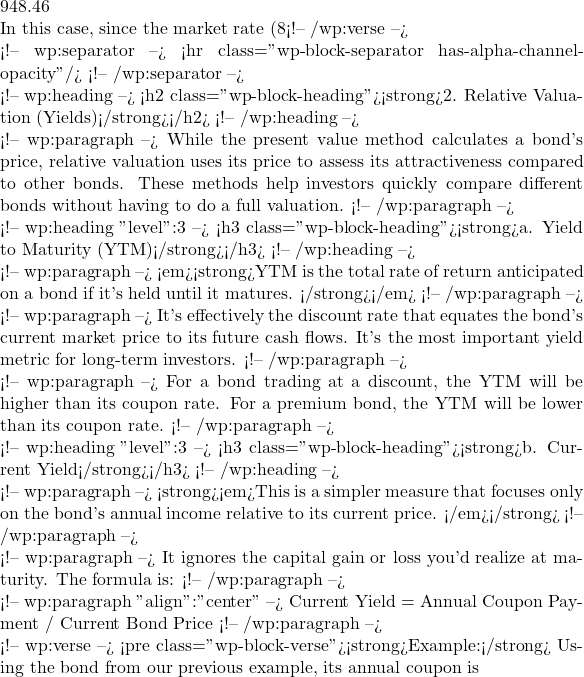
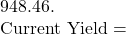
Let's value a bond with a face value of60), and 3 years to maturity. The current market interest rate for bonds of similar risk is 8%. Year 1: 55.56 Year 2: 51.44 Year 3: 47.63 Year 3 (Face Value): 793.83 By summing these present values, we get the bond's total value: V = 51.44 + 793.83 = 60 and its current price is 60 / $948.46 = 0.0633 or 6.33%










c. Yield to Call (YTC)
This is a measure used for callable bonds, which allow the issuer to redeem the bond before its maturity date.
YTC calculates the return if the bond is called at the earliest possible date.
3. Advanced Methods
For more complex or illiquid bonds, analysts use more sophisticated models to account for factors like changing interest rates or embedded options.
a. Arbitrage-Free Valuation (Spot Rates)
This method values each of a bond’s individual cash flows (each coupon and the final face value) using a different discount rate, known as the spot rate, from the market’s yield curve.
This approach assumes that there should be no opportunity for a risk-free profit (arbitrage) in the market, making it more accurate for valuing specific bonds.
b. Matrix Pricing
This technique is used to value bonds that don’t trade frequently.
It estimates the appropriate yield for a new or illiquid bond by using the Yield to Maturity (YTM) of other, more liquid bonds with similar characteristics (same issuer, credit rating, and maturity).
Final Thoughts
While the core principle of bond valuation remains the present value of future cash flows, the method you choose depends on the bond’s complexity and your investment goals.
For most investors, understanding the relationship between interest rates and prices and using key metrics like YTM are the most powerful tools for making informed decisions.

