This article explains the difference between production in the short run and production in the long run.
Also, it describes, calculates and illustrates costs of production in the short run. It also explains why average cost curve has the U shape. You will be able to understand that the short run average cost curve is U-shaped due to Law of Diminishing Returns.
It uses the concept of marginal returns to explain the various stages of Law of Diminishing Returns. Diminishing returns set in when output is still rising but at a falling rate.
Costs of production in the short run
There are various payments during production, which have to be made whether they are for a marketing campaign, materials, workers salaries’ or something as simple as the rent. These various types of costs can be categorized in different ways to help make decisions and see how efficiently a company is operating.
Output, or quantity produced (Q), is the amount a company produces.
1. Fixed Costs (FC): Fixed Costs (FC) are those that do not change as output changes. They must be paid whether or not a business is trading. These can also be called overheads or indirect costs. Common examples are rent and salaries for managers.
2. Variable Costs (VC): These are costs which change as output increases. Examples include packaging or raw materials. For example, a car company needs steel. If they produce 50% more cars than before, they will need to buy more steel. This will increase their variable costs – spending on steel.
3. Total Costs (TC): The sum of all Fixed Costs (FC) and Variable Costs (VC):
Total Costs (TC) = Fixed Costs (FC) + Variable Costs (VC) * Q
When the business produces 4,000 units and Variable Costs (VC) are USD
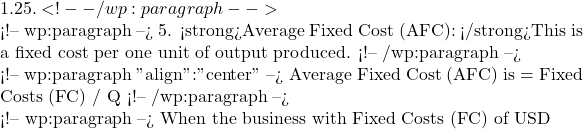
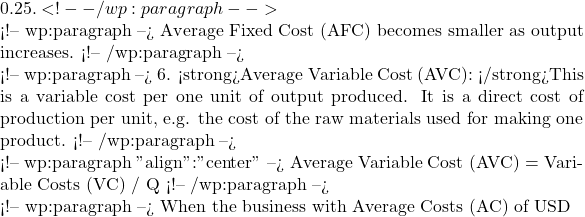
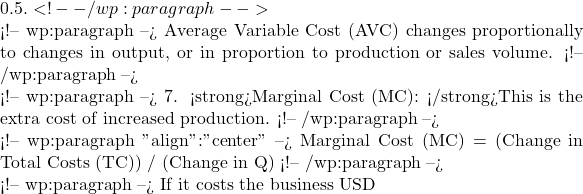
![5,000. <!-- /wp:paragraph --> <!-- wp:separator --> <hr class="wp-block-separator has-alpha-channel-opacity"/> <!-- /wp:separator --> <!-- wp:html --> <script async="" src="https://pagead2.googlesyndication.com/pagead/js/adsbygoogle.js?client=ca-pub-3196649779609103" crossorigin="anonymous"></script> <!-- Inside Content --> <ins class="adsbygoogle" style="display:block" data-ad-client="ca-pub-3196649779609103" data-ad-slot="4855547878" data-ad-format="auto" data-full-width-responsive="true"></ins> <script> (adsbygoogle = window.adsbygoogle || []).push({}); </script> <!-- /wp:html --> <!-- wp:separator --> <hr class="wp-block-separator has-alpha-channel-opacity"/> <!-- /wp:separator --> <!-- wp:paragraph --> 4. <strong>Average Cost (AC): </strong>This is a cost per unit how much it costs to produce one unit of output. <!-- /wp:paragraph --> <!-- wp:paragraph {"align":"center"} --> Average Cost (AC) is = Total Costs (TC) / Q <!-- /wp:paragraph --> <!-- wp:paragraph --> When the business produces 4,000 units and Total Costs (TC) of producing 4,000 unit is USD](https://www.SuperBusinessManager.com/wp-content/ql-cache/quicklatex.com-b1b77f4b61bf53c162473e9972260158_l3.png "Rendered by QuickLaTeX.com")



Law of Diminishing Returns causes the U-shaped average cost curve
The table shows how various types of costs change depending on the output produced by the business. Let’s assume that all costs are in USD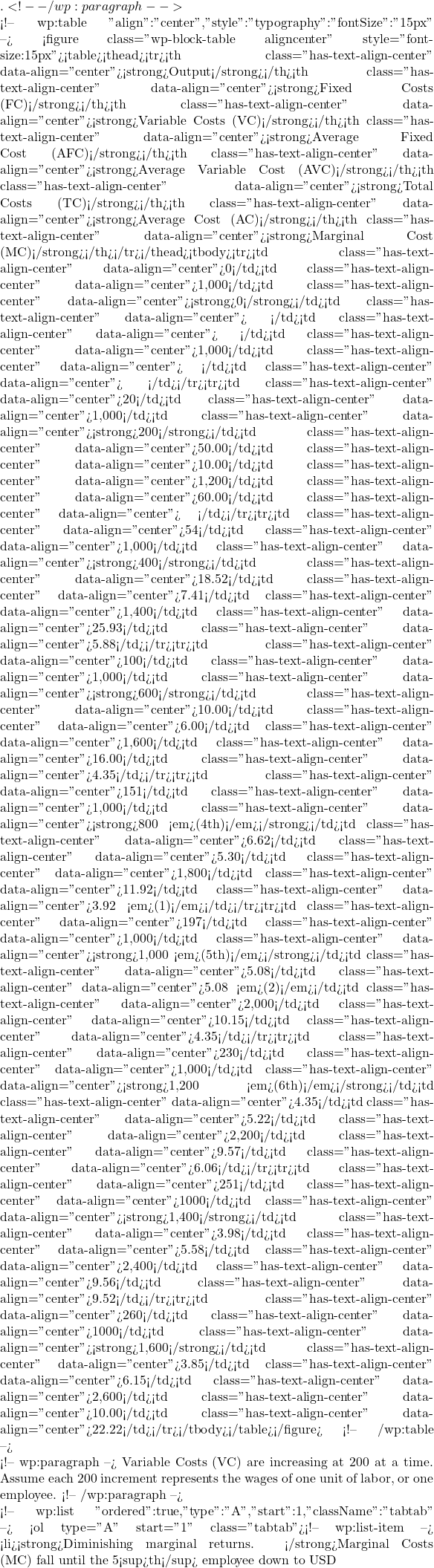

- Diminishing average returns. Average Variable Costs (AVC) fall until the 6th employee down to USD$5.08. Therefore diminishing average returns (2) set in between the 5th and 6th unit of labor.
Therefore, when looking at the diagrams, the short run average cost curve has a U shape because of the law of diminishing returns. At first costs fall due to increasing returns then rise due to diminishing returns.
The following diagram shows how Average Total Costs (TC), Average Variable Costs (AVC) and Marginal Costs (MC) are plotted on a graph.


NOTE: The marginal cost curve ‘cuts through’ the Average Cost (AC) curve at its lowest point. When the MC is smaller the AC, the AC decreases. This is because when the extra unit of output is cheaper than the average cost, then the AC is pulled down. Similarly, when the MC is greater than the AC, the AC is pulled up. The point of intersection between the MC and AC curves is also the minimum of the AC curve. This can be explained by the fact that when the cost of the marginal output is equal to the average cost of the output, then the AC neither falls nor rises, i.e. it reaches its minimum.
Summary
As marginal product becomes greater than before, a firm will experience increasing returns. The average costs will begin to fall.
As marginal product becomes less than before, a firm will experience diminishing returns. The average costs will begin to rise.


Comments are closed.