Assets:
Cash:  30M
30M
Plant & Equipment (at liquidation value):  200M
200M
Liabilities:
Accounts Payable:  80M
80M
Total Liabilities = As you can see, no single valuation method is perfect. Each has its strengths and weaknesses, and the best analysts use a combination of these techniques to arrive at a more robust valuation range. For example, a DCF model might provide a theoretical value based on future growth, while a comparable company analysis provides a reality check against current market sentiment. The key takeaway is to look beyond the current share price. By understanding the intrinsic value of a company, you can make more informed, rational investment decisions and potentially uncover great opportunities that the rest of the market has overlooked. You don’t just buy a stock based on its current price, do you? Wise investors know that a company’s market price can be influenced by all sorts of things, from market sentiment to temporary news cycles. The real question is: Is the stock’s price reflective of its actual worth? This is where equity valuation comes in. It’s the process of determining the “intrinsic value” of a company’s stock—what it’s really worth based on its fundamentals, not just its current trading price. By understanding a stock’s intrinsic value, you can decide whether it’s a bargain (undervalued), overpriced (overvalued), or fairly priced, which is the cornerstone of successful, long-term investing. Here are the most common ways investors and analysts value stocks. Absolute valuation models, also known as intrinsic valuation, attempt to determine a company’s value on its own, without referencing other companies. They are based on the idea that the value of an asset is the present value of all its future cash flows. This is arguably the most comprehensive valuation method. The DCF model projects a company’s future cash flows—the cash a business generates from its operations after accounting for capital expenditures—and then discounts them back to their present value using a “discount rate” that reflects the risk of the investment. A stock is considered undervalued if its calculated DCF value is higher than its current market price. The DCF model projects a company’s future cash flows and then discounts them back to their present value using a “discount rate” (typically the Weighted Average Cost of Capital, or WACC) that reflects the risk of the investment. This model is a variation of the DCF model, but it focuses specifically on the dividends a company is expected to pay to its shareholders. It calculates a stock’s value as the present value of its future dividend payments. This method is best for mature, dividend-paying companies with a history of consistent dividend growth, as it’s not suitable for non-dividend-paying stocks. The DDM is a variation of the DCF model, but it focuses on dividends instead of free cash flow. It’s most suitable for stable, mature companies with a history of consistent dividend payments. The Gordon Growth Model is a common version of the DDM. The formula is: Value = D1 / (r − g) Where: D1: Expected dividend per share next year r: Required rate of return (or discount rate) g: Expected constant growth rate in dividends This method values a company by looking at the prices paid for similar companies in past mergers and acquisitions (M&A). It’s more common in corporate finance and M&A advisory, as it gives a sense of the value a company could fetch in a sale. This approach is less about future earnings and more about what the company is worth if it were to liquidate. It calculates a company’s value by summing the fair market value of its assets and subtracting its liabilities. This is the value of a company if it were to be shut down and its assets were sold off. It’s often considered the “floor” for a company’s value, representing the minimum amount an investor could expect to receive. This method is most useful for companies in distress or for those with a lot of physical assets. Assets: Cash: Plant & Equipment (at liquidation value): Liabilities: Accounts Payable: Total Liabilities = As you can see, no single valuation method is perfect. Each has its strengths and weaknesses, and the best analysts use a combination of these techniques to arrive at a more robust valuation range. For example, a DCF model might provide a theoretical value based on future growth, while a comparable company analysis provides a reality check against current market sentiment. The key takeaway is to look beyond the current share price. By understanding the intrinsic value of a company, you can make more informed, rational investment decisions and potentially uncover great opportunities that the rest of the market has overlooked. I am the Founder and Editor-in-Chief of the SuperBusinessManager.com website. I am the EU citizen with approximately 20 years of experience in secondary and higher business education in both public and private sectors. Currently living with my wife and our two adorable children in China where I teach Business Management and Economics at K-12 international schools. Professionally, I am an experienced Lecturer and Researcher in Business Management and Economics, as well as IB Examiner for DP Business Management at International Baccalaureate (IB). Privately, I enjoy reading and collecting books on business management, personal finance and investing. You can contact me at jerrygrzegorzek@hotmail.com 200M –
  100M
100M
The liquidation value of Widgets Inc. is $100 million. This represents a “floor” for its valuation, as this is what shareholders could theoretically receive in a shutdown.Final Thoughts
1. Absolute Valuation Models
A. Discounted Cash Flow (DCF) Model
Example: Let's value "Tech Innovations Inc." with a WACC of 10%. We project its Free Cash Flow (FCF) for the next five years and assume a terminal growth rate of 3% beyond that.
Step 1: Project Future Cash Flows
Year 1 FCF:  110 million
Year 3 FCF:  140 million
Year 5 FCF:  100 / (1 + 0.10)^1 =
  110 / (1 + 0.10)^2 =
  125 / (1 + 0.10)^3 =
  140 / (1 + 0.10)^4 =
  155 / (1 + 0.10)^5 =
  90.91 +
  93.91 +
  96.24 =
  155 × (1 + 0.03)) / (0.10 − 0.03) =
  2,280.7 million
Step 4: Calculate the Present Value of the Terminal Value
PV of TV =  1,416.1 million
Step 5: Sum it all up
Intrinsic Value = Sum of PVs of FCFs + PV of TV
Intrinsic Value =  1,416.1 =
  1,883.7 / 100 =
  15, the stock may be undervalued.
B. Dividend Discount Model (DDM)
Example: Let's value "Steady Dividends Corp." Its last dividend was
 2.00 × (1 + 0.04) =
  2.08 / (0.08 − 0.04) =
  52.00
52.00
According to this model, the intrinsic value of Steady Dividends Corp. is  50 million. We select three comparable companies in the same sector.
 Company Market Cap Net Income P/E Ratio (Market Cap/Net Income) FTI (Target) ?  1.2B
1.2B 2.0B
2.0B 1.5B
1.5B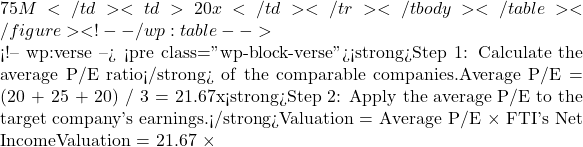 50 million =
  1.08 billion.
B. Precedent Transaction Analysis
Example: A competitor of Future Tech Inc. was recently acquired for 20x its EBITDA (Earnings Before Interest, Taxes, Depreciation, and Amortization). If FTI's EBITDA is
 70 million =
  1.4 billion.
3. Asset-Based Valuation
A. Liquidation Value
Example: Let's assume a manufacturing company, "Widgets Inc.," has the following on its balance sheet:
30M200M80M200M – 100M
The liquidation value of Widgets Inc. is $100 million. This represents a “floor” for its valuation, as this is what shareholders could theoretically receive in a shutdown.Final Thoughts
